
Vijay Balakrishnan on how Godrej Enterprises Group (GEG) is scaling enterprise AI through intelligent platforms, AI agents, and a responsible AI-led transformation.
Today, large enterprises are no longer struggling to identify AI use cases. The real challenge lies in deciding where to begin, scaling AI responsibly, and aligning people, processes, and platforms behind a unified transformation strategy.
Godrej Enterprises Group (GEF) is driving this transformation at significant scale. A diversified Indian conglomerate spanning both consumer and industrial sectors, the group operates primarily through Godrej & Boyce and its affiliated businesses. Its portfolio ranges from home appliances and security solutions to advanced engineering systems supporting India’s space, infrastructure, and industrial programs.
With operations across 14 business verticals, a presence in more than 60 countries, and annual revenues nearing Rs 21,000 crore, the group has accelerated modernization initiatives across manufacturing, supply chain, customer experience, finance, procurement, and commercial operations over the past year.
Leading this transformation is Vijay Balakrishnan, who brings more than two decades of experience in driving digital transformation within manufacturing-led enterprises. Under his leadership, GEG has moved beyond foundational cloud modernization and platform consolidation to build enterprise-wide AI capabilities through initiatives such as Factory 360 and Amethyst, its internal AI and intelligence orchestration platform.
In a recent interaction with Jatinder Singh, Chief Editor, ET Edge CIO&Leader, Balakrishnan discusses how GEG is scaling AI across the enterprise, why responsible AI must be embedded from the outset, how AI agents are being integrated into business functions, and why the future of enterprise AI will depend less on experimentation and more on disciplined prioritization. Excerpts from the interaction:
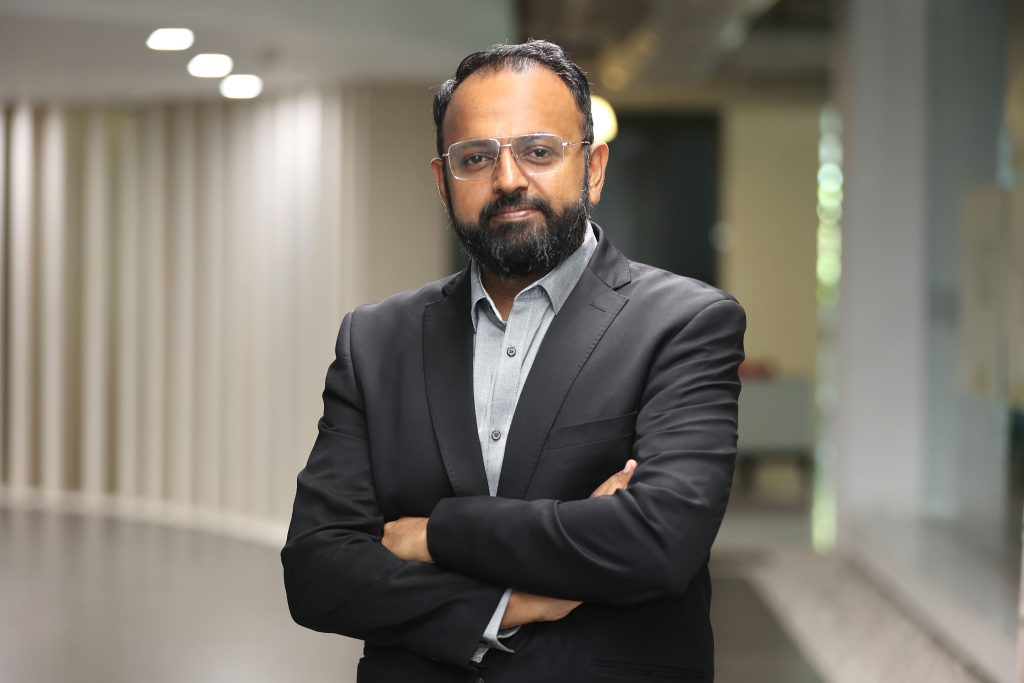
Chief Digital & Information Officer
Godrej Enterprises Group
CIO&Leader: GEG has been accelerating its digital and AI transformation journey over the last few years. Could you walk us through how that journey evolved, starting from foundational modernization and cloud adoption to building enterprise-wide AI capabilities like Amethyst?
Vijay Balakrishnan: This is the fourth major transformation program I’ve led in my career, and one thing I’ve learned is that every successful transformation kicks off with strong foundations. At Godrej Enterprises Group, the main focus was on platform modernization, cloud-first adoption, and the creation of a long-term technology strategy that could scale with the business. When I joined, the organization was already committed to this direction, with a strong emphasis on accelerating and completing the modernization journey.
In many ways, joining at that stage proved advantageous because we were able to learn from industry experiences, follow best practices, and avoid several of the early pitfalls that organizations faced during digital transformation initiatives. Alongside infrastructure and platform modernization, we also started reimagining enterprise processes, building group-wide systems, and strengthening analytics capabilities across the organization.
Our approach was different. We did not spend years building a huge, centralized data program or pick just one platform partner, then work through AI use cases one at a time. Instead, we focused on being agile and experimenting, running several POCs, pilots, and phased rollouts at the same time. This sped up our progress and cut down timelines by months.
The biggest change came with generative AI. Suddenly, AI was almost plug-and-play. Our systems were already producing reliable data, giving us a solid foundation. However, gen-AI also brought a new challenge: hallucination. Because these models are basic and built outside the company, organizations cannot fully control the information they use.
That is the point where intelligence becomes critical. I often compare it to hiring an experienced professional from outside the company. They may bring deep expertise and broad knowledge, but they still need guidance on how your organization operates, which policies to follow, how decisions are made, and how work should be executed within your environment. In the physical world, that guidance comes from policy documents, managers, peers, and organizational culture. In AI, that guidance must come through an enterprise intelligence layer.
This idea led to the creation of Amethyst.
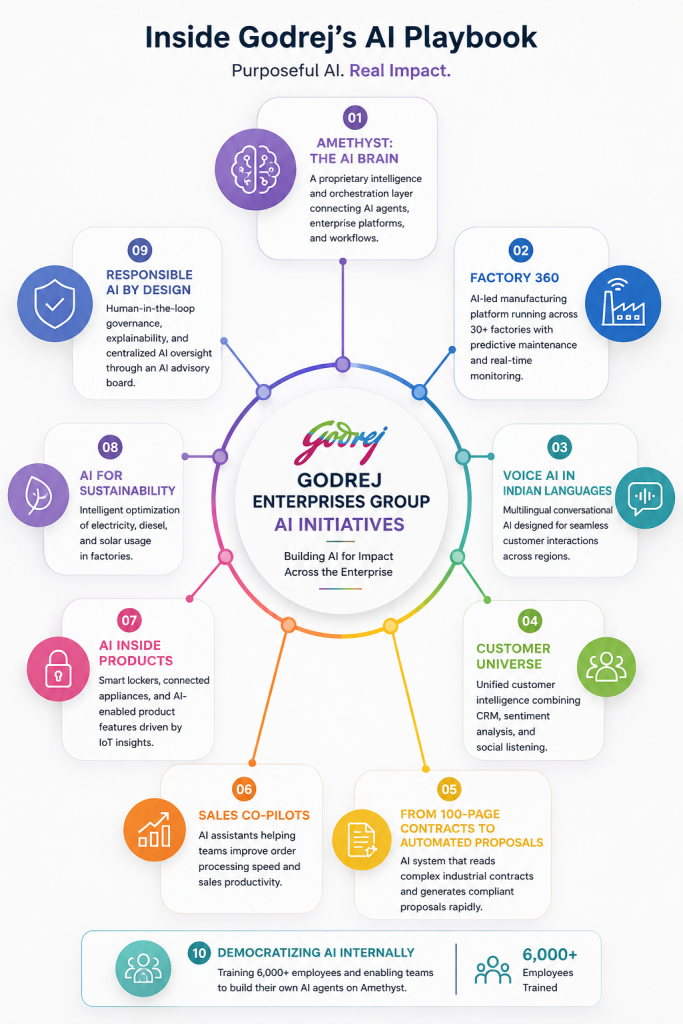
Amethyst is our enterprise intelligence layer. It helps fit AI into the real needs of our organization. With Amethyst, AI systems and agents use trusted company knowledge, processes, and governance, which lowers the risk of hallucinations and makes them more reliable.
Today, we are close to completing the foundational aspects of our modernization journey. While we had already begun experimenting with AI, the progress over the last 18 months has significantly accelerated our AI roadmap. We are now driving impact across multiple internal processes and have already deployed several production-grade AI agents across the enterprise. More importantly, we continue to rapidly scale these capabilities.
From the beginning, security has remained integral to our approach. As a result, we are now looking at AI from two perspectives simultaneously: cybersecurity for AI — ensuring AI systems remain secure, governed, and trustworthy — and AI for cybersecurity, where AI itself becomes a force multiplier for strengthening enterprise security operations.
Responsible AI cannot be an afterthought — it has to be built into the architecture from day one.
CIO&Leader: Many enterprises are still struggling with pilot fatigue, production-scale deployment, and proving real business impact from AI initiatives. What do you think has enabled you to accelerate AI adoption more effectively?
Vijay Balakrishnan: We learned early on that using AI in isolated areas does not create real business value. For example, AI in customer service is only as good as the supply chain, service, and logistics systems behind it. If those systems are not connected, AI just makes inefficiencies more obvious.
That’s why we take a holistic approach. We look at the whole design-to-delivery value chain and use AI across connected processes, not just in separate functions. The main challenge now is not finding where to use AI but figuring out the best order to scale it.
We set our priorities based on business impact, feasibility, data readiness, process maturity, and how well people adopt new tools. By focusing on these areas, we have moved past pilot fatigue and scaled AI more effectively throughout the company.
CIO&Leader: Could you explain the key AI use cases you are focusing on across customer experience, manufacturing, and enterprise operations, and how you decide where AI can create the maximum impact?
Vijay Balakrishnan: Our AI strategy is fundamentally hybrid and closely aligned with our wider platform vision. On the enterprise side, we have invested heavily in cloud-native ERP, CRM, and planning platforms with robust APIs that enable both data access and workflow automation. For specialized manufacturing needs, we built Factory 360, which today supports over 30 factories, alongside Amethyst, our enterprise intelligence and orchestration layer.
Amethyst, our enterprise intelligence and AI orchestration layer, has three main roles. It acts as the intelligence layer, serves as an agentic AI platform built on frameworks like LangGraph and LangChain, and works as the orchestration engine that connects workflows across systems and functions. We do not view AI as a set of separate use cases. Real impact happens when manufacturing, supply chain, logistics, planning, and customer service all work together as one connected value chain.
One of our largest initiatives has been Customer UID, which unifies sales, service, and marketing interactions inside a single customer platform. By combining transactional data, sentiment analysis, and social insights, we are enabling far more personalized customer engagement.
We are also launching a multilingual Voice AI platform that lets users switch easily between Indian languages during conversations. This delivers customer interactions that feel almost human and ensures every call is answered.
In manufacturing, we use AI for predictive maintenance, sensor-based asset monitoring, full traceability, and improving sustainability in our factories. AI is also being added to connected products and IoT systems, making them smarter and more responsive.
Inside the company, we are automating complex workflows across different functions. For example, in our furniture business, we have automated most of the B2B order processing from start to finish.
In all these projects, our goal is the same: to improve agility, business efficiency, and customer experience on a large scale. We look at AI agents almost like digital employees. Every agent has a human owner who is ultimately accountable for its performance and outcomes.
CIO&Leader: Have you been able to track any efficiency gains or business outcomes from these deployments?
Vijay Balakrishnan: It’s a complex question because ROI depends on the use case. I always focus on early indicators for ROI. In the end, ROI appears in the P&L, and for AI projects, it usually affects the bottom line.
Top-line impact is harder to prove. For example, if sales improve, how much credit goes to AI versus everything else happening in the organization? That’s always debatable.
But when it comes to productivity, we are seeing improvements of 10 to 15 percent, and in some areas, more than 50 percent.
Sometimes, it is about increasing output with the same number of people, which helps us avoid extra costs. In the B2B order-booking example, we have increased throughput by nearly five times with the same team.
In some cases, our dependence on external agencies has been reduced dramatically.
But I always return to early indicators. If people focus only on immediate P&L results, they may become skeptical too soon and miss bigger opportunities.
CIO&Leader: And to what extent does this ecosystem rely on partnerships with companies like Microsoft, OpenAI, or hyperscalers, versus on capabilities built internally?
Vijay Balakrishnan: Our approach is hybrid. Amethyst itself runs on AWS, our strategic cloud partner. We use some native AWS components and build others ourselves. But the real intelligence layer is custom-built internally. At the same time, we leverage native AI agents within our CRM and ERP platforms through Amethyst.
CIO&Leader: And how critical is proprietary data in making these platforms effective?
Vijay Balakrishnan: Very important. Our philosophy is simple: first, make processes lean, then digitize them, and build strong data before scaling AI. In other words, optimize the process, digitize it, build a solid data foundation, and add AI only then.
Earlier, each of these stages required independent focus, and organizations would spend months progressing from one layer to the next. Today, technology has evolved to the point where companies can move across these dimensions simultaneously and progressively, accelerating the overall transformation journey.
One of the strengths of our organization is the way we have structured functional councils across manufacturing, services, and marketing. Since we operate through 14 business units, these councils bring together functional leaders to establish common process ownership and governance. This allows us to standardize processes even before digitization begins, creating a firm foundation for transformation.
The second aspect is where things become more subtle. Traditionally, platform transformation and data transformation were treated separately. However, many modern enterprise platforms now inherently ensure reliable, high-quality, and consistent data through native APIs. As a result, the earlier split focus between platform modernization and data readiness is no longer necessary in many cases.
There are still situations where dedicated data interventions are required, and we continue to address those separately. But for core enterprise systems such as CRM, ERP, S&OP, and HCM, the architecture itself is increasingly designed to deliver structured, reliable data at scale. If these platforms are implemented well — especially after lean process standardization — they naturally generate better-quality data.
And then comes AI. As I mentioned earlier, the activation time for AI has reduced dramatically.
CIO&Leader: What does responsible AI mean in practice for Godrej, and how are you building governance, accountability, explainability, and monitoring frameworks for AI use across the organization?
Vijay Balakrishnan: The first thing we did was establish an AI Advisory Board comprising top management, business leaders, and key functional heads. Every major AI initiative is reviewed and vetted through that governance structure.
Second, for us, responsible AI fundamentally means keeping humans in the loop. We do not believe in completely autonomous systems because there are too many socioeconomic variables, business nuances, and unpredictable drifts involved.
For us, AI agents work much like digital employees. Each agent has a human owner who is responsible for its performance, decisions, and results. Just as managers are responsible for their teams, there must be clear human accountability for AI systems.
An additional essential pillar for us is explainability. This becomes especially important in areas such as demand or sales forecasting, or in decision-support systems, where outcomes could influence incentives or business decisions. Users must clearly understand why a recommendation is being made.
We have added governance features directly into Amethyst to reduce hallucinations, cut down on bias, and make sure responses fit our business context. The platform also has clear rules: if a question is not related to work, the system will not answer.
Overall, our philosophy is clear: responsible AI should be part of the architecture and operating model from the start. For us, it is truly ‘responsible AI by design.’
CIO&Leader: How are you addressing the increasing challenge of Shadow AI, which many CIOs and CISOs see as a major governance and security concern?
Vijay Balakrishnan: Instead of fearing Shadow AI, we have built a safe environment that encourages innovation. We have added governance, hallucination control, and bias filtering directly into the main platform.
In fact, I think it should be encouraged, as long as it is done responsibly.
We have been investing significantly in employee AI awareness and developing AI capability across the organization. Last year, we provided about 600,000 hours of AI-related training, and close to 6,000 employees completed foundational AI learning programs. The wider objective is to make AI adoption increasingly inclusive and empower employees to use these technologies confidently and responsibly. With a secure platform like Amethyst, employees can confidently create their own knowledge agents, and soon, even their own actionable agents.
To strengthen governance even more, we are building an AI Command Center. We already have an early version running, and by the end of this year, it will be fully set up.
We are also cautious about free public LLMs because of security risks. Employees might accidentally share sensitive information, underscoring the importance of cybersecurity awareness and responsible platform use.
Instead of treating Shadow AI as a threat, we chose to create a secure, fail-safe environment that enables employees to innovate responsibly.
CIO&Leader: Are you seeing a shift in the balance between automation, augmentation, and the kind of skills the organization now prioritizes?
Vijay Balakrishnan: As a company, we have core values and responsibilities that do not change. We are mainly working to reduce human involvement in agency and contract work. If we do not use AI to improve efficiency in these areas, we are not serving the organization well.
For our internal employees, the focus is on helping them do more with AI. As a growing company, we have been adding to our workforce every year. AI might slow hiring in some areas, but we still need strong engineering talent. That will not change.
People are open to AI when it helps with the frustrating parts of their daily work. If an employee sees that an agent can handle repetitive, boring tasks, they are more likely to use it.
CIO&Leader: With GEG planning to invest nearly Rs 1,200 crore into AI-led initiatives, what are the key strategic priorities and transformation areas you see forming the organization’s AI roadmap over the next few years?
Vijay Balakrishnan: For us, employee safety is still one of our top priorities. We are using AI, computer vision, drones, and Amethyst-powered monitoring systems to create a smarter safety system in our factories and customer areas. The goal is to move from reacting to problems to using proactive and predictive systems that spot risks and help make workplaces safer with real-time monitoring and intelligence.