
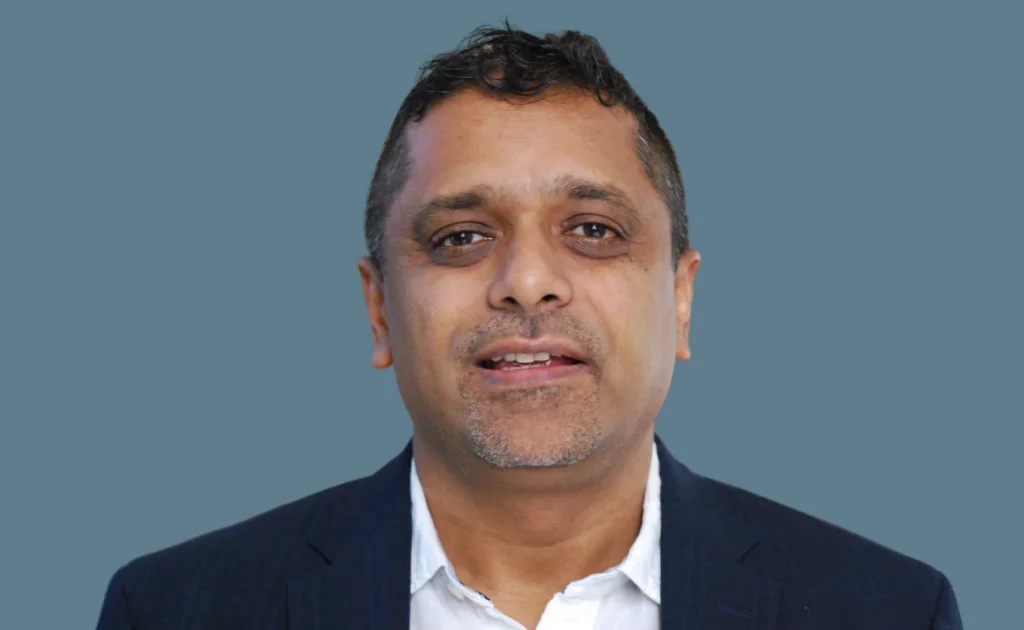
Sajan Paul of HPE Networking explains how AI-native, self-driving networks, built-in security, liquid cooling, AI grids and autonomous operations will help enterprises simplify complexity while preparing infrastructure for the AI era.
As artificial intelligence reshapes enterprise IT, networking is undergoing one of its most significant transformations since the advent of cloud computing. AI workloads, hybrid environments, distributed applications and an expanding threat landscape are pushing enterprise networks beyond the limits of manual operations. At the same time, Indian organisations are grappling with infrastructure complexity, cybersecurity risks, talent shortages and sustainability challenges as they modernise for the AI era.
In this interview Sajan Paul, General Manager, HPE Networking India, discusses HPE’s vision for autonomous networking, why security must be embedded into network architecture from the ground up, how the integration of Juniper and Aruba is shaping the company’s networking strategy, and what enterprise networks could look like over the next five years.
CIO&Leader: HPE has spoken extensively about self-driving networks. What does this vision mean in practice for enterprise CIOs?
Sajan Paul: Networks have evolved far beyond being simple connectivity layers. Today, they are the strategic foundation for digital transformation, hybrid cloud, Industry 4.0 and AI-driven business models.
That transformation has also introduced enormous complexity. There are now more than 35 billion connected devices worldwide, and every new branch, IoT deployment, cloud application or remote user increases operational complexity. Enterprises depend on networks for mission-critical operations while simultaneously facing networking skill shortages and an expanding attack surface.
Security has to be thought through from the ground up, right from designing hardware to designing a software stack, and then through its entire life cycle.
Managing this complexity manually is becoming unrealistic.
That’s why HPE is building AI-native networking, where AI becomes a foundational capability rather than an add-on. AI continuously analyses network behaviour, predicts failures, detects anomalies and optimises performance in real time.
The next step is the self-driving network.
Our vision is to build networks that continuously learn, optimise, heal and increasingly operate autonomously across the enterprise, not just for isolated use cases but across the complete networking environment. This remains one of HPE Networking’s highest strategic priorities globally.
CIO&Leader: As AI expands the enterprise attack surface, how should organisations rethink network security?
Sajan Paul: I prefer calling it secure-native networking.
Just as organisations have embraced cloud-native and AI-native architectures, security must also become native to the network. It can no longer be treated as a layer added after deployment because threats evolve far too quickly.
Security has to be designed into every layer, from hardware architecture and software development to the operational lifecycle.
Security has to be thought through from the ground up, right from designing hardware to designing a software stack, and then through its entire life cycle.
Take a network with one thousand devices. If a critical vulnerability is discovered, organisations cannot afford months to deploy patches. That’s why HPE has adopted a microservices architecture.
Instead of relying on monolithic software, every networking function operates independently. If one component is affected, it doesn’t compromise the entire system, and individual services can be updated rapidly across thousands of devices without replacing the entire software stack.
The second pillar is Zero Trust.
We assume no network is inherently trusted. Internally, we describe this as “Coffee Day networking”—whether you’re in your office, working remotely or connected through public Wi-Fi, the security posture should remain identical.
This philosophy underpins our Secure Edge portfolio, SD-WAN, Secure Service Edge (SSE) and Zero Trust Network Access (ZTNA) architecture.
We’re also preparing for the post-quantum era. Quantum computing could fundamentally weaken today’s encryption methods, so HPE Labs is already investing in quantum-safe security architectures to help organisations prepare before the threat becomes reality.
CIO&Leader: HPE recently announced deeper integration between Juniper Mist and Aruba Central. What does this mean for customers?
Sajan Paul: Our guiding principle throughout the Juniper acquisition has been simple: no customer should be left behind.
Both Aruba and Juniper have strong customer communities, and our objective is to preserve those investments while creating additional value through integration rather than forcing migrations.
An important advantage is that both Aruba Central and Juniper Mist were built on cloud-native, microservices architectures. That common foundation allows us to introduce new AI capabilities rapidly across both platforms.
Rather than replacing one platform with another, we’re making the customer experience increasingly consistent.
A useful analogy is Android and iOS. Different operating systems, but users expect similar application experiences. That’s exactly the direction we’re taking.
Capabilities available in Mist, particularly AI-driven operations, will progressively become available in Aruba Central. Likewise, Aruba’s strengths in identity services and customer intelligence will become available in Mist.
Hardware flexibility is equally important.
Customers often ask whether they should choose Aruba or Juniper hardware. Our answer is that whichever platform they choose, it will continue to be fully supported.
We’ve even introduced a dual-personality access point capable of operating with either Aruba Central or Mist.
Ultimately, by combining the strengths of both portfolios, we believe we’re creating one of the industry’s most comprehensive platforms for AI-driven, self-driving network operations.
CIO&Leader: AI workloads have introduced entirely new networking requirements. How is HPE supporting hyperscalers and private cloud operators?
Sajan Paul: There are really two conversations today.
The first is AI for Networking, where AI automates and simplifies network operations.
The second is Networking for AI, which is about building infrastructure capable of supporting increasingly demanding AI workloads.
Modern AI generates enormous east-west traffic between GPUs, storage and compute clusters. Networking performance directly affects AI training times and inference speed.
The key metric is no longer simply bandwidth—it’s job completion time.
At HPE Discover, we introduced our Broadcom Tomahawk 6-based platform delivering 1.6 terabits per second per port and 102.4 terabits per second of switching capacity.
Equally important, these switches are fully liquid cooled.
Liquid cooling reduces power consumption, increases rack density and enables data centres to maximise increasingly scarce space. Today, operators even evaluate AI infrastructure using metrics such as tokens generated per square foot.
Beyond hardware, software orchestration is equally important.
We’ve integrated our Apstra Intent-Based Networking platform to automate network deployment and lifecycle management while maintaining operational consistency across large AI environments.
We’re also expanding operating system flexibility by supporting both Junos OS and SONiC, the open-source networking operating system increasingly adopted by hyperscalers.
Whether organisations deploy NVIDIA clusters, AMD infrastructure or private AI environments, the network should never become the bottleneck. It should accelerate AI training and inference while simplifying operations.
CIO&Leader: India continues to face challenges around power, sustainability and networking skills. How can enterprises address these constraints while scaling AI infrastructure?
Sajan Paul: Scaling AI infrastructure isn’t simply about deploying more GPUs. Organisations must optimise power, cooling, utilisation and connectivity together.
Liquid cooling is one of the most significant technologies enabling this transition. Drawing from HPE’s supercomputing expertise, we’ve adapted liquid cooling into networking to improve thermal efficiency, reduce power consumption and minimise infrastructure footprint.
Sustainability also depends on utilisation.
In reality, network switches rarely operate at full capacity continuously. Traffic fluctuates, leaving processing resources idle.
We’ve therefore developed AI-driven sustainability algorithms that monitor hardware utilisation and intelligently power down unused processing components without affecting performance.
Beyond individual devices, enterprises must rethink infrastructure deployment itself.
Finding abundant power, cooling and connectivity in a single location is becoming increasingly difficult. Instead of building one massive AI factory, organisations are creating multiple AI facilities distributed across different locations and connecting them through ultra-low-latency networking.
We refer to this as the AI Grid. Several AI factories, connected through high-speed networking, can function as a single intelligent infrastructure while providing greater resilience and scalability.
HPE is investing heavily in these ultra-low-latency interconnects and advanced traffic engineering to make distributed AI infrastructure practical.
CIO&Leader: Looking ahead, what will enterprise networking look like five years from now?
Sajan Paul: We’re much closer to autonomous networking than many people realise.
A few years ago, self-driving cars seemed futuristic. Today, they’re already operating commercially in several parts of the world.
I believe self-driving networks will follow a similar trajectory. Given the pace of innovation, many of these capabilities could become mainstream within the next three years.
The self-driving network will become an imminent reality. I’d be surprised if it will happen in less than three years.
Of course, autonomous networking depends on continuous learning.
AI systems are only as good as the operational data used to train them, which is why HPE continues investing heavily in improving model accuracy, validating outcomes and enhancing AI explainability.
Transparency will become increasingly important as enterprises need confidence in how AI systems make decisions.
We’re already seeing humans shift from operational execution towards architecture and governance.
Just as software developers increasingly act as system architects rather than writing every line of code, network engineers will spend less time performing repetitive operational tasks and more time designing policies, architectures and governance frameworks.
That said, I don’t believe humans will disappear from the process. Compliance, governance and critical decision-making will continue to require a human-in-the-loop.
Looking further ahead, the boundaries between servers, compute, networking, storage and software will continue to blur.
Self-driving capabilities won’t remain confined to networking—they will increasingly extend across the entire enterprise technology stack, creating infrastructure that is autonomous, intelligent and capable of managing itself while allowing IT teams to focus on higher-value strategic outcomes.