
GCPL’s India CIO on embedding data, AI into business decision-making
As Godrej Consumer Products Limited (GCPL) steps up its ambition to become a truly intelligent, data-led enterprise, technology is no longer something that quietly supports the business from behind the scenes. It is now deeply embedded into the core of how the organisation thinks, decides, and operates, helping teams move faster, make sharper decisions, and deliver measurable business impact across functions.

In a recent interaction with Jatinder Singh, Editor, CIO&Leader, Vishal Gupta, Head – IT, Business Transformation and Digital (India & SAARC) at GCPL, outlines how the multi-billion-dollar FMCG company—with a strong presence across emerging markets in Asia, Africa, and Latin America, operating in over 80 countries and serving 1.4 billion consumers— is re-architecting its digital core, embedding data and AI into everyday decision-making, and scaling technology-led execution across sales, supply chain, manufacturing, and finance.
Vishal also shares how GCPL is moving from merely building data lakes to driving real decision impact, while balancing speed with responsibility as it explores emerging technologies such as agentic AI.
He outlines how the company is strengthening a resilient, secure digital foundation to support growth across diverse and complex markets.
Excerpts from the interview.
CIO&Leader: How is GCPL’s digital transformation strategy shaping business outcomes, and what tangible benefits have you observed so far?
Vishal Gupta: Our digital transformation strategy is focused on three pillars: modernising and simplifying our digital core, leveraging data and AI to make better decisions, and digitising processes to unlock speed and efficiency. As these capabilities mature, we are seeing very tangible business outcomes.
The digital core is our foundation. We have accelerated modernisation through Azure migration, SAP S/4HANA, and a unified enterprise backbone, strengthening resilience, scalability, and reducing tech debt.
Digital core forms the bedrock of the organisation, and we have accelerated both modernisation and simplification of the core over the last few years. The journey began with migrating to Azure, followed by a seamless upgrade to SAP S/4HANA. Subsequently, we migrated our Africa business to SAP, enabling a single, integrated, enterprise-wide digital backbone. We are also modernising our data platform and standardising our secondary sales systems globally.
All these measures have strengthened resilience, enabled us to scale faster while maintaining business continuity and also reduced tech debt.
In the digitisation of processes, we do not view technology as a set of tools but rather as a strategic enabler of business outcomes that touches every part of the value chain. It has delivered benefits, including improved field force productivity, enhanced supply chain efficiency, and redirected organisational bandwidth from routine tasks to value-adding activities. For instance, our distributor replenishment orders for 1500+ distributors are all system-generated, with no manual intervention, ensuring high customer fill rates, adherence to inventory norms, and freeing up sales bandwidth.
Our focus on Data and AI is enabling an intelligent enterprise. Data and algorithms are driving decision-making at scale and with greater agility than ever before. For example, our 3000+ strong field force, servicing a million-plus outlets, is empowered with real-time data, which is improving agility and precision in the market. High-impact decisions, such as media planning, pricing and promotions, sourcing, etc., are all data-driven and deliver tangible P&L impact.
Overall, our digital transformation strategy aligns with our business strategy of radical simplification, providing fuel for growth and delivering tangible benefits through increased productivity, better decision-making, improved customer experience, and measurable contributions to business growth. Digital is not a parallel agenda; it is embedded in the organisation’s DNA.
CIO&Leader: GCPL operates across highly diverse channels and markets. How are you embedding digital capabilities across sales, supply chain, and support functions to improve execution, decision-making, and scalability at an enterprise level?
Vishal Gupta: As we embarked on reimagining our digital transformation journey a few years back, the fundamental principle we adopted was that the transformation needs to be broad-based and should be deeply embedded in all the functions of the organisation.
For example, in Sales, we are leveraging technology extensively to serve our consumers better, regardless of the channel or platform they use to buy our products.
In General Trade, we have a field force of 3,000+ serving a million-plus retail outlets. Technology is not an option but a necessity to drive sharper last-mile execution. Let me talk about three specific areas of digital interventions.
We have geo-tagged our entire outlet universe, which has enabled scientific route planning and enabled us to identify white spaces and micro-market opportunities for distribution expansion and right assortment. Secondly, we have implemented a sales control tower that provides real-time performance visibility and automated nudges to drive immediate corrective actions. We also use predictive analytics to ensure the right assortment in every outlet, with the right trade discounts, to maximise throughput/outlet. All of these measures have helped improve productivity, increase outlet coverage and revenue/DSR.
India has a large and diverse rural market with lakhs of villages. The role of technology here is to help drive profitable rural expansion. We have leveraged data and technology to identify and prioritise villages based on potential, optimise territory design, and determine the right sub-stockist locations to service these villages.
In alternate channels, we leverage technology to drive discoverability, availability and offtakes. In modern trade, our merchandisers are enabled through an AI-based image recognition tool to drive in-store execution. Similarly, in e-commerce, we use data and analytics to monitor the digital shelf and also improve the effectiveness of performance marketing spends.
In the Supply chain, we are accelerating our efforts to digitise the entire value chain to drive best-in-class customer fill rates, reduce inventory days, and lower supply chain costs. We are also implementing an advanced supply chain planning platform that will enable integrated end-to-end demand, production, and distribution planning. Our ambition is to move towards a no-touch planning system and management by exceptions.
We are also adopting Industry 4.0 solutions, which include IoT sensors, energy monitoring systems, vision systems for quality and safety, and predictive maintenance. These technologies will enable improved OEE, reduce downtime, and enhance safety.
Our digitisation journey is not limited to line functions like sales or supply chain, but also includes support functions. For example, in finance, a unified data and analytics platform ensures finance leaders have accurate, real-time visibility into business performance. We have automated routine tasks such as reconciliations, reporting, and invoice processing through workflow tools and RPA, enabling our teams to focus on more strategic work.
Our digitisation goes beyond sales and supply chain to support functions like finance, where real-time data and automation are freeing teams to focus on more strategic work.
These are a few examples of how, at GCPL, we are embedding technology across the organisation and unlocking value through faster decision-making, improved efficiency, and higher productivity.
CIO&Leader: As CIO, how do you evaluate emerging technologies and drive organisational change so that digital initiatives deliver sustained business value, not just quick wins?
Vishal Gupta: AI, cloud, and automation are evolving faster than ever. The challenge isn’t just adopting them quickly; it’s adopting them wisely. We follow three simple principles: Relevance, Readiness, and Results. Technology has to create real business value, have the team on board, and actually make a difference in growth, efficiency, and customer experience.
Change management is fundamental to any technology initiative. Before we embark on any transformation, we carefully assess not just the technical aspects but also the organisation’s preparedness to absorb and sustain change. Every transformation is driven in close partnership with the business. Project charters are co-created with business leaders, outcomes are clearly defined upfront, and accountability is shared. This ensures strong organisational buy-in and alignment from the very beginning.
Change management is fundamental to any technology initiative. Before we embark on any transformation, we carefully assess not just the technical aspects but also the organisation’s preparedness to absorb and sustain change.
In addition to the above challenges, Cybersecurity remains a top focus. Threat landscapes are becoming more sophisticated, and as digital adoption increases, so does our risk surface. We are strengthening our zero-trust architecture, investing in real-time monitoring, and embedding security into every layer of our ecosystem. But beyond tools, we’re also building a strong security culture, because employees are our first line of defence.
The above challenges are real, but we are approaching them with the right strategy, governance, and culture shifts so that our transformation journey is effective and sustainable.
CIO&Leader: Many companies have data lakes, but few achieve real decision impact. How has GCPL moved from data to predictive, prescriptive decision-making at scale?
Vishal Gupta: Our digital investments have shifted deliberately toward building insight-rich, AI-first organizations. At the heart of this is our enterprise data lake on Azure, consolidating data from sales, marketing, operations, finance, and external sources into a single source of truth. This powers predictive and prescriptive analytics across the value chain.
For example, supply planning teams now use machine learning models that dynamically incorporate seasonality, price changes, promotions, weather, and competitive intensity, significantly improving forecast accuracy.
AI solutions are widely deployed to sharpen sales execution across general and modern trade. Route optimization, assortment recommendations, and AI-based monitoring of physical and digital shelves ensure the right products, at the right price, in the right channels.
We also leverage data and AI extensively in media planning, pricing, promotions, and sourcing decisions. India’s heterogeneous media market, with countless digital and print channels, has seen media planning transformed by MASH, our in-house platform that optimizes media spend, reduces external dependencies, and enables agile, business-aligned decisions.
Pricing and promotion decisions are algorithm-driven, modeling impact on volume and market share while maintaining profitability guardrails. Sourcing decisions consider commodity prices, logistics costs, and capacity constraints to optimize total delivered cost.
By integrating a cloud-based data lake with AI platforms, we are creating a unified ecosystem where data and intelligence drive business decisions from sourcing to sales execution.
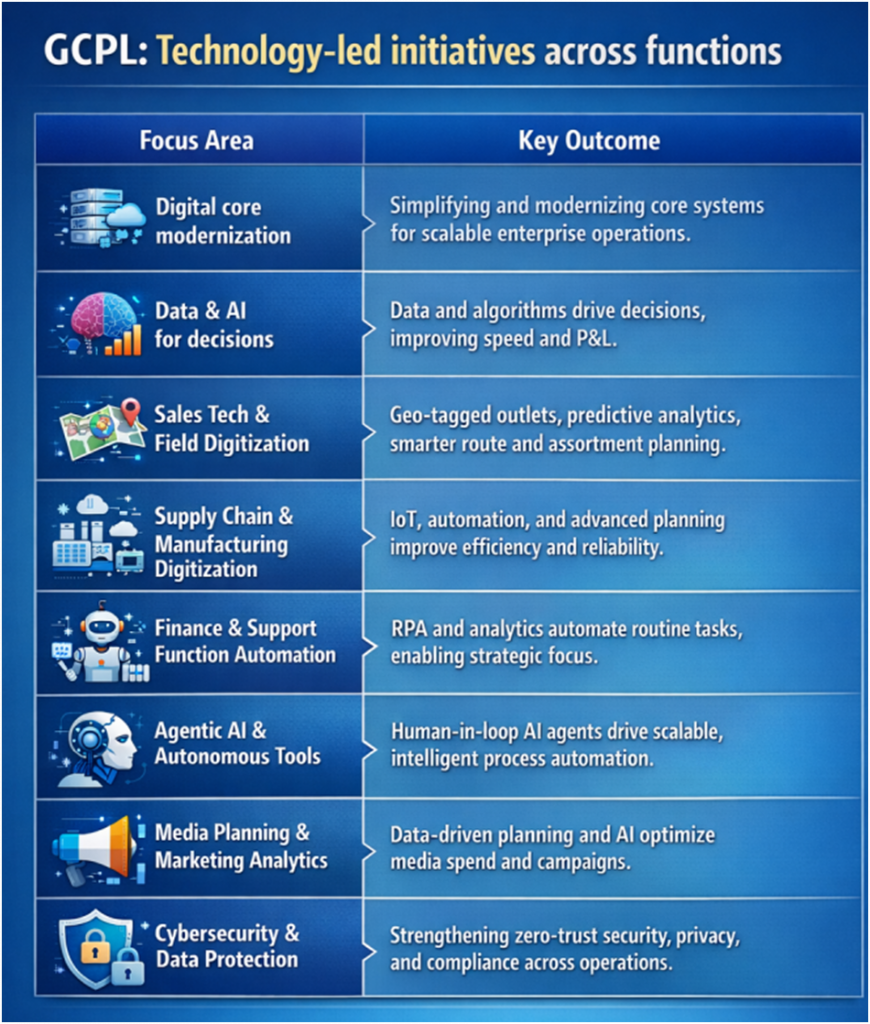
CIO&Leader: How is GCPL exploring Agentic AI and autonomous tools, and could 2026 be their breakthrough year?
Vishal Gupta: At GCPL, we see agentic AI and autonomous decision-making tools as the next major leap in unlocking speed, efficiency and scalability. Our approach is to adopt these technologies in a thoughtful and controlled manner with human-in-the-loop.
There are use cases at different stages of evaluation. The use of autonomous agents for end-to-end process orchestration, rather than traditional RPA-based automations, can unlock efficiencies at a massive scale. For example, an AI sales agent can fetch outlet order history, demand forecasts, and distributor inventory, and autonomously initiate a voice/chat conversation with a retailer to place a replenishment order and close the loop by integrating the order with the DMS system.
Agentic AI systems can also augment traditional ML models for demand forecasting, sourcing, and pricing decisions, making them more agile and responsive to changes. Another use case is agentic co-pilots, which act as intelligent assistants that can surface insights, improve decision-making quality, and enable faster responsiveness to shifts in consumer preferences, category trends, or demand patterns.
AI agents can also autonomously monitor the effectiveness of digital media buying or performance marketing spends on E-commerce platforms and recommend corrective actions.
But as we explore the use of agentic and autonomous systems, we are conscious that governance is critical. There needs to be guardrails around responsible and ethical AI, data quality, data protection and privacy to ensure trust and reliability.
Agentic AI represents the next leap, but it must be adopted with humans in the loop and strong ethical, data, and privacy guardrails.
CIO&Leader: Which technology investments will matter most for GCPL in the near term as you balance scale, efficiency, and innovation across diverse markets?
Vishal Gupta: While we have taken significant leaps in our digital transformation journey over the last few years, we firmly believe the most impactful years are ahead of us.
Looking ahead, our key technology focus areas fall into five broad themes:
First, data and AI: We aim to accelerate the adoption of Generative AI to augment traditional ML models across demand forecasting, pricing, and market execution. We will also be expanding the use of AI in product innovation, consumer and market research and content generation.
Second, automation at scale: Agentic AI and autonomous systems hold great potential to scale automation and unlock efficiencies.
Third, sales execution excellence: We continue to invest in sales tech and scale digital platforms, especially in rural and emerging channels like Q commerce.
Fourth, a digitally enabled supply chain and manufacturing footprint: Industry 4.0 capabilities, digital control towers, and innovative planning tools are critical, especially as we scale new greenfield plants.
Finally, data protection and privacy: As digital adoption increases, we are strengthening cybersecurity to ensure trust, compliance, and business continuity. We are also doubling down on controls for how we acquire, process, store, and retain PII data.