How Indian Enterprises Are Learning to Make AI Work Responsibly, Economically, and at Scale.
Artificial intelligence has moved decisively beyond experimentation in Indian enterprises. The real challenge today is not whether AI can work, but how it can be scaled responsibly without runaway costs, fragile governance, or unintended workforce disruption.
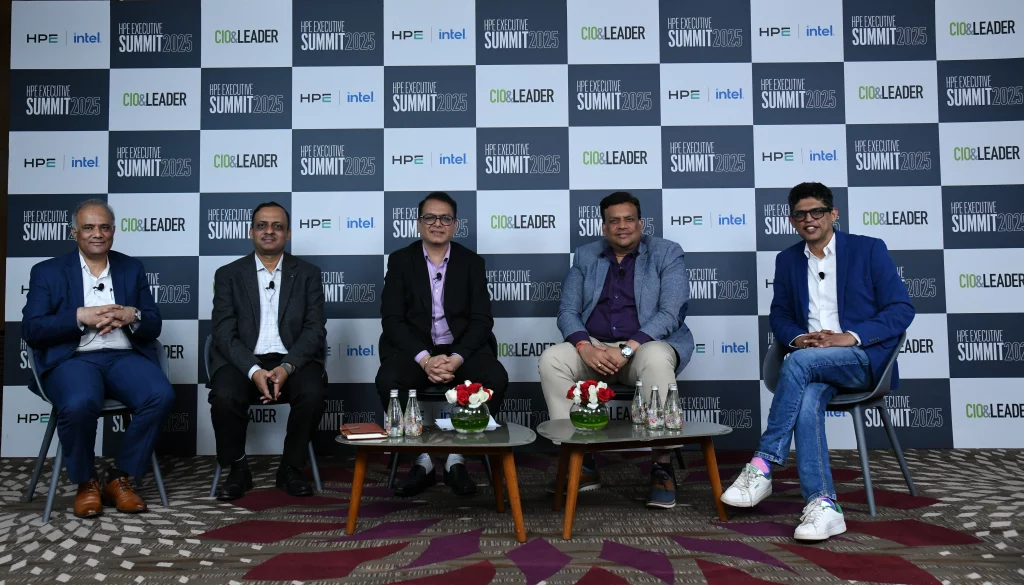
This concern gained clarity during a CIO&Leader Studio Talk at the HPE Executive Summit, where senior technology leaders shared grounded, experience-led insights on what it truly takes to move AI from pilots to production.
Focus matters more than speed
Deepak Bhosale, Associate Vice President – IT, Asian Paints’ experience reflects a broader industry reality. AI technologies are evolving at breakneck speed, with newer and better models emerging every quarter. While this creates opportunity, it also introduces instability. Enterprises often find themselves midway through implementation when a more powerful model appears, forcing difficult trade-offs between continuity and competitiveness.
“AI pilots excite everyone, but real discipline begins when you productionise. The key is not doing a hundred AI projects but choosing a few high-impact ones and going deep, with a clear eye on value and cost.” ~ Deepak Bhosale
The bigger challenge, however, arrives during production. Cloud usage, prompt volumes, and user adoption drive costs sharply upward, challenging traditional ROI assumptions. The lesson, according to the panel, is clear: AI scale demands prioritisation. Depth matters more than breadth, and impact matters more than experimentation for its own sake.
The business case comes first in AI
Ashish Desai, CIO, Aditya Birla Group – Global Textiles Business believes that successful AI adoption starts with business clarity, not technology choice. AI use cases must be identified based on what truly matters to the business, as priorities differ across industries. Instead of solving isolated problems, organisations should design AI initiatives around end-to-end processes that integrate multiple systems and data sources.
“AI is not really about the technology; it is about what the business wants to achieve, and that will vary from industry to industry. The real challenge is identifying the use case that truly makes a difference.” ~ Ashish Desai
Real value emerges when AI connects operations such as manufacturing, utilities, IoT, ERP, and supply chains into a unified workflow. Clear problem definition and outcome articulation are critical technology already exists, but integration and intent determine success.
Infrastructure is silent enabler of AI outcomes
While strategy and governance dominate most AI conversations, Rajesh Garg, President & Group CIO, Yotta Infrastructure Solutions, brought attention to a less visible but decisive factor: infrastructure.
“AI outcomes depend on infrastructure readiness.” Without scalable, high-performance, low-latency systems, even the best AI use cases cannot deliver real value.” ~ Rajesh Garg
As enterprises adopt large language models and GPU-intensive workloads, the demands on infrastructure have escalated dramatically. Training models, serving real-time inference, and meeting ultra-low latency expectations require architectures built for scale from day one. In this environment, infrastructure is no longer a backend concern; it is a strategic differentiator.
Taking accountability while redesigning AI
Ramesh Narayanaswamy, CTO, Aditya Birla Capital Limited, highlighted that while enterprises have made significant progress in organising and using data over the last five to six years, data strategy remains an ongoing journey, especially in organisations shaped by mergers and acquisitions, where complexity is inevitable. However, he stressed that the bigger challenge lies in workforce transformation.
“AI is not just changing technology; it is changing organisational design. If we eliminate entry-level work without rethinking career paths, we risk creating a talent vacuum in the future.” ~ Ramesh Narayanaswamy
As AI scales, it will fundamentally reshape organisation design, not just automate tasks. Entry-level roles are increasingly being absorbed by AI, creating the risk of future talent gaps if career pathways are not rethought. Romesh also pointed out that traditional annual budgeting and ROI models are poorly suited to AI’s fast, project-driven nature, calling for more flexible approaches to skills, roles, and value measurement.
A Measured Path Forward
The collective message from the panel was clear and reassuring. Scaling AI is not about chasing every new model or racing competitors. It is about balance—between ambition and economics, experimentation and governance, automation and human growth.
Enterprises that align infrastructure readiness, disciplined use-case selection, shared accountability, and workforce evolution will be best positioned to turn AI into sustained business value. As the leaders concluded, the future of AI belongs not to the fastest adopters, but to the most thoughtful ones.