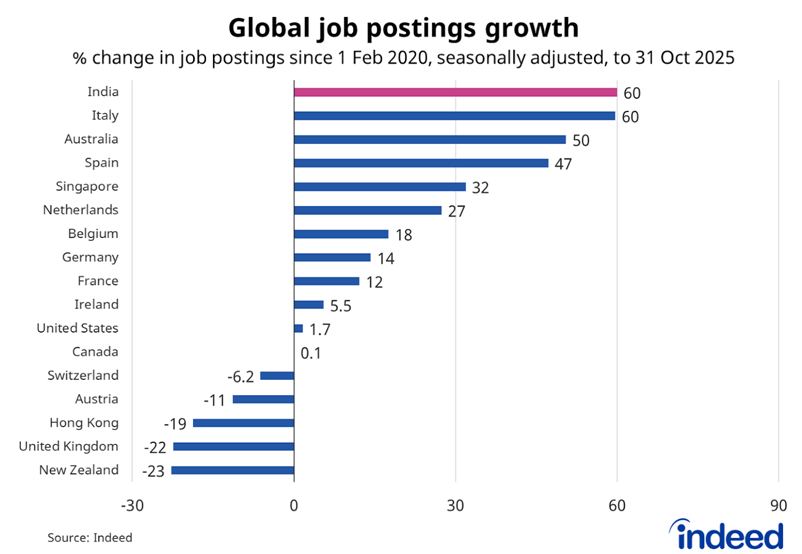
New data from global hiring and matching platform, Indeed, shows that formal job creation in India softened further in October, with job postings down 5.6% on the platform. This marks the second consecutive month of decline, leaving postings 19.8% lower than a year ago. Despite that, Indian job postings are 60% above pre-pandemic levels, but have fallen 25% since their peak in January 2023.
Callam Pickering, Indeed’s APAC Senior Economist, said, every month, the Indian workforce gradually transitions towards more formal work arrangements. As the nation transitions, job creation in the formal sector is expected to outpace overall employment growth nationwide. This transition is also why job postings in India have been stronger than in other Indeed markets, both during the post-pandemic job boom and the subsequent slowdown.
Recent posting growth mixed across occupations
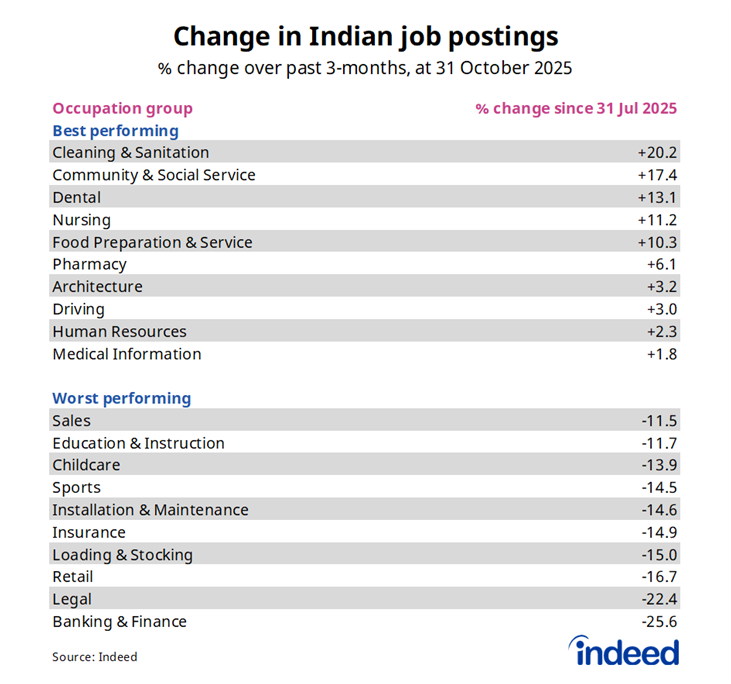
Over the past three months, job postings declined in almost three-quarters of occupations. Yet even in a softening job market, there will still be some strong performers, and the past three months have been no exception.
Job postings in cleaning & sanitation rose around 20% over the past three months, ahead of community & social service (+17.4%), dental (+13.1%), nursing (+11.2%) and food preparation & service (+10.3%). Another positive was the posting for human resources, which climbed 2.3%.
However, these gains were more than offset by weakness in banking & finance, where postings fell 25.6%, along with legal (-22.4%), retail (-16.7%) and loading & stocking (-15.0%).
India’s latest remote work trends
In October, 9.1% of Indian job postings explicitly mentioned phrases such as ‘work from home’ or ‘work remotely’ in their job descriptions. That’s up from 7.6% a year ago.
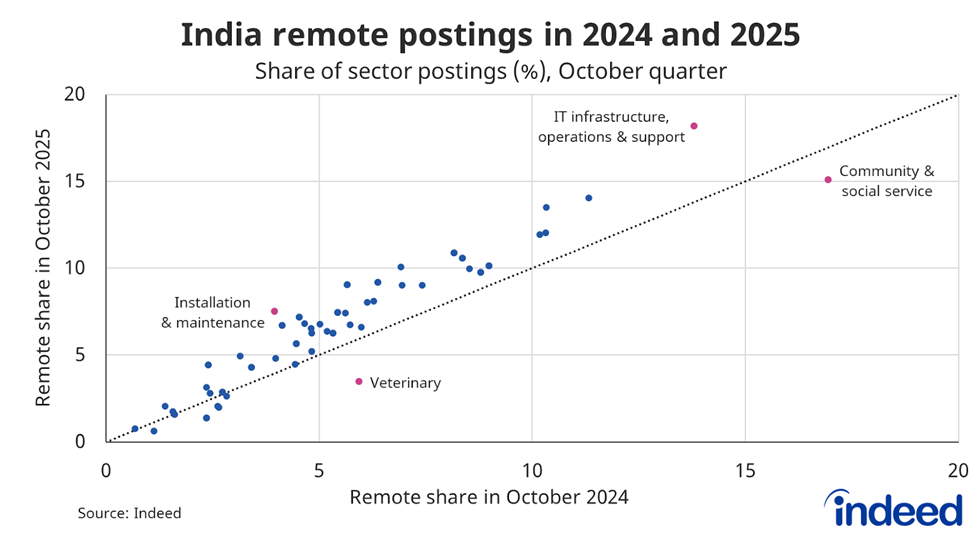
Remote opportunities are most common in IT infrastructure, operations & support at 18.2% of postings in the October quarter 2025, ahead of community & social service (15.1%) and industrial engineering (14.0%).
The remote share can also vary considerably from year-to-year. Over the past year, the share has increased the most in IT infrastructure, operations & support (+4.4 percentage points) and installation & maintenance (+3.4 percentage points). By comparison, large declines were observed for veterinary (-2.5 percentage points) and community & social service (-1.9 percentage points). In the October quarter, the remote posting share was higher in 84% of occupational categories compared to the same quarter a year ago.
Mr Pickering added, changes in remote work arrangements can reflect shifting attitudes among employers, particularly with regard to work-from-home mandates. It may also reflect employers’ attempts to attract more candidates.
Conclusion
Job creation continues to soften, but Indeed job postings remain well above pre-pandemic levels. India appears to be creating more than enough jobs to support their ongoing economic transition, with the unemployment rate stable at 5.2%. India’s larger challenge is ensuring that the skills of its workforce match the skills demanded by employers. Many employers across India are seeking highly skilled workers in technology and management, but that doesn’t always align with what job seekers have to offer. Consequently, India’s unemployment rate tends to be higher on average than in other countries throughout Asia