
Accessible learning tools can help learners with visual impairment build greater independence in education and skill development.
A student-led learning aid demonstrates how accessibility can be embedded into product design—giving blind and low-vision learners greater independence while opening potential pathways to vocational skills.
As education becomes increasingly digital, accessibility is often discussed in terms of screen readers, voice interfaces and software compliance. Yet meaningful inclusion requires a broader design approach—one that recognizes that learner’s access and process information in different ways.
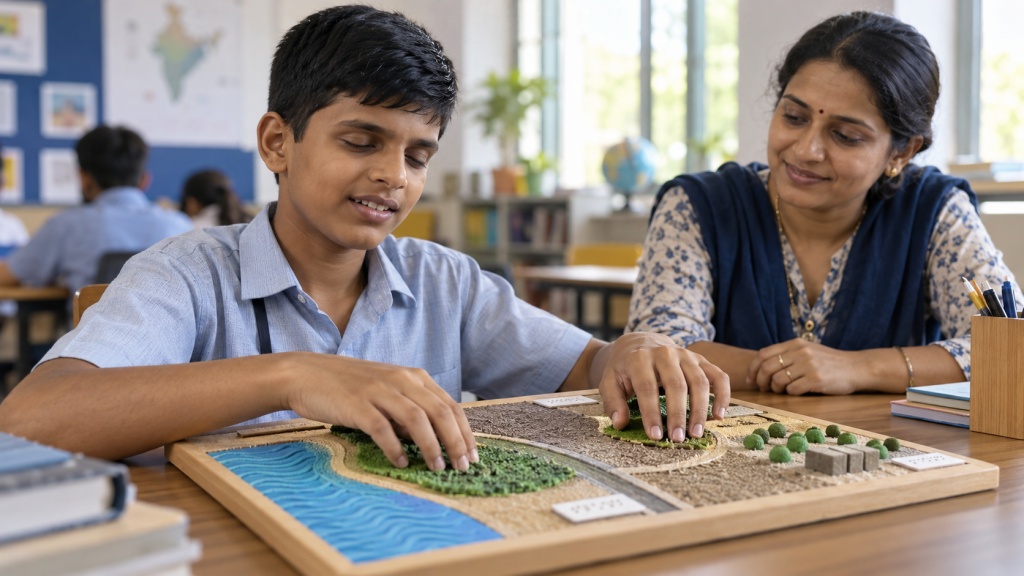
For blind and low-vision learners, tactile resources can translate information that is otherwise difficult to communicate through text, diagrams or screens. When designed thoughtfully, such tools can promote independent learning, improve confidence and introduce skills that may eventually support vocational opportunities.
A tactile educational aid developed by Avishi Gupta, a Class XI student progressing to Class XII at Jayshree Periwal International School, offers a practical example of this approach. Her project is designed to help blind and low-vision learners understand the standard acupressure point-map of the human foot through touch.
Translating visual information into touch
The human foot’s acupressure map is conventionally presented as a visual diagram, making it difficult for learners with visual impairment to study independently. Gupta’s apparatus translates this information into a tactile format using raised-relief zones, differentiated textures and Braille labels.
These elements allow users to locate and identify individual acupressure points and understand their association with different body systems. The current version comprises 55 placards representing the complete foot point-map.
Importantly, the kit is positioned as an educational resource rather than a therapeutic or diagnostic device. Its purpose is to make an existing body of knowledge more accessible and enable users to explore it with greater independence. Since the labels are presented in Braille, learners require basic Braille and tactile literacy to use the resource effectively.
The design also illustrates a larger principle relevant to technology and product leaders: accessibility works best when it is built into the structure of a solution rather than introduced later as an accommodation. Instead of expecting the learner to adapt to a visual resource, the project redesigns the information around the learner’s mode of understanding.
From classroom inclusion to skill development
The potential value of the initiative extends beyond the classroom. For adults with visual impairment, tactile familiarity with acupressure concepts could provide an introductory foundation for structured vocational training in acupressure and related touch-based disciplines.
This does not mean that an educational kit alone can establish professional competence. Formal instruction, supervised practice and appropriate certification would remain essential. Nevertheless, accessible foundational resources can help learners determine their interest, develop familiarity with terminology and prepare for more advanced training.
That distinction is important. Inclusive learning should not be measured only by whether information is technically available. It should also be assessed by whether learners can use that information independently and convert learning into confidence, capability and, where appropriate, livelihood opportunities.
Testing accessibility with intended users
Inclusive products cannot be evaluated solely by their creators. They must be tested by the people expected to use them.
The concept underwent a documented user trial on 6 May 2026. Shivani Bharadwaj, founder of Inside Me NGO, shared videos and written feedback showing two blind adults physically testing the kits. Bharadwaj has also provided a letter of recommendation for the project.
Although a limited trial does not constitute comprehensive validation, involving intended users is a meaningful step in an iterative design process. Their feedback can reveal whether textures are sufficiently distinct, Braille labels are positioned appropriately and the overall navigation of the kit is intuitive.
Gupta is currently applying for the Pradhan Mantri Rashtriya Bal Puraskar. According to information shared about the initiative, the kit is also expected to be displayed at the MIT Museum.
A wider lesson for enterprise leaders
For CIOs and technology leaders, the project offers a useful reminder: innovation does not always require a complex digital platform. It can begin with identifying where conventional design excludes a group of users and then rethinking how information is structured and delivered.
The same principle applies to enterprise systems, digital services and workplace tools. Accessibility should be considered at the design stage, tested with actual users and evaluated against practical outcomes—not treated merely as a compliance requirement.
As organisations adopt AI, automation and increasingly digital operating models, they must also ensure that new interfaces do not create fresh barriers. Multimodal design—combining visual, auditory and tactile modes where appropriate—can help technology serve a wider range of users.
Gupta’s initiative remains an early-stage educational project, but its underlying message is significant: inclusive design can turn information into agency. By enabling learners with visual impairment to explore knowledge independently, tactile learning resources can widen participation and create new pathways towards education, skills and economic opportunity.