
In a conversation with CIO&Leader, Srinivasa Raghavan S, Director of Product Management at ManageEngine, unpacks how Indian enterprises are racing to modernize their digital infrastructure — and why the conversation around IT operations has fundamentally shifted from passive monitoring to proactive, intelligence-driven resilience.
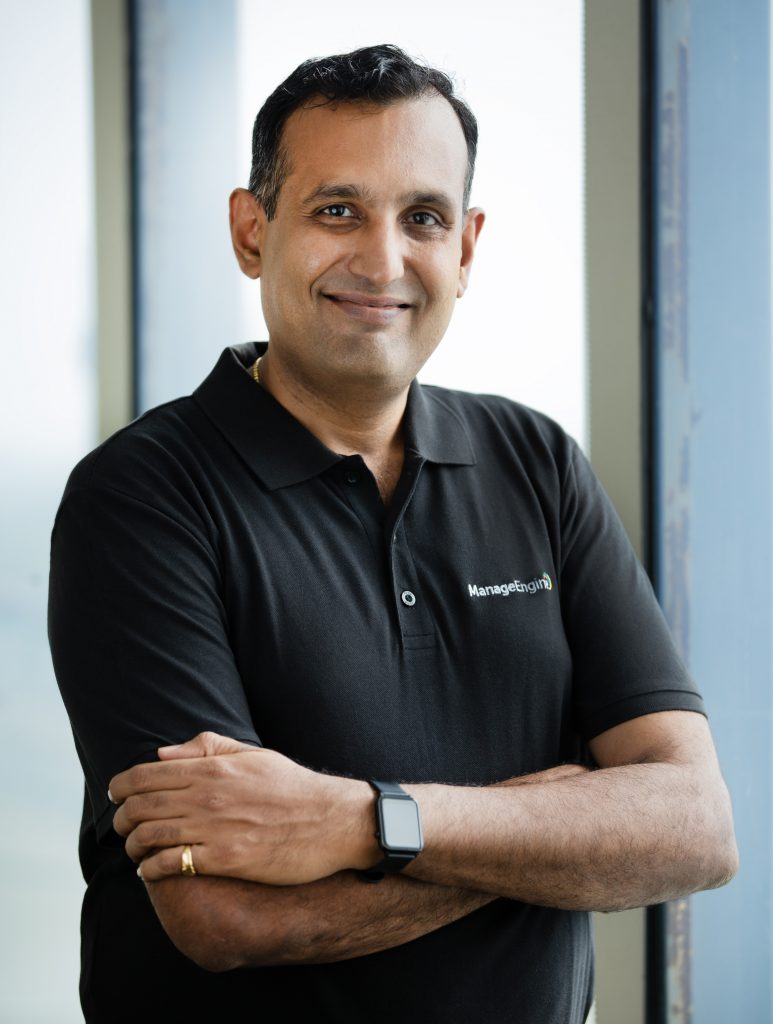
Director of Product Management
ManageEngine
At the center of this transformation is a quiet but profound revolution: AI systems that don’t just alert, they act. Raghavan walks through how domain-aware causal AI is cutting through alert noise, why “self-driving observability” is no longer a buzzword but a boardroom priority, and how enterprises can embrace autonomous remediation without sacrificing governance or accountability. The future of IT ops, he argues, isn’t just smarter — it’s self-correcting.
CIO&Leader: How are Indian enterprises evolving from traditional monitoring to intelligent IT operations today?
Srinivasa Raghavan S: Indian enterprises began with static, threshold-based monitoring, then moved to adaptive thresholds, and then to correlation and automation: each stage compressing the gap between detection and resolution. That progression, which took most markets the better part of a decade, has played out in India in three to four years, driven by the rapid adoption of cloud-native architectures, containerization, and microservices.
The pace of that shift is not accidental. Sectors like BFSI, telecom, and e-commerce have been operating at a scale where reactive monitoring was never going to be sufficient. India’s digital payments infrastructure alone processes billions of transactions monthly, a scale that places its observability requirements in a league of its own.
That pressure has produced measurable outcomes. IIFL, one of India’s largest retail broking organizations and a Site24x7 customer, saw detection time drop from 5-10 minutes to 2-3 seconds. And the TCO came down to 20%. Issues that were previously reaching the technology team through customers were now caught before anyone felt them.
The frontier today is autonomous remediation: detecting a degradation pattern, tracing it to its origin, and resolving it before an SLA is breached or the NOC receives an escalation. CIOs are no longer asked how many servers are monitored. Instead, they are asked how quickly the organization can detect, contain, and recover. That question has reframed the conversation from monitoring as a safety net to observability as active intelligence. The shift is already underway, and momentum is only building.
CIO&Leader: What role does domain-aware causal AI play in reducing alert noise and improving incident response?
Srinivasa Raghavan S: Alert noise is one of the most significant problems in IT operations. When engineers receive hundreds or thousands of alerts a day, they begin filtering by instinct; most of which are duplicates, false positives, or symptoms of a single underlying issue. Things get missed. The platform has technically alerted on everything and caught nothing that actually matters.
Domain-aware causal AI changes this entirely. It understands the service dependency of the environment, how changes propagate through a topology, and what normal behavior looks like across varying load conditions and time periods. In short, it can distinguish between a symptom and a cause.
What looks like thirty separate events are often one problem wearing thirty faces. This can be a combination of various factors including spike in database latency, elevated error rates in an application service, timeouts in an API gateway, and a degraded synthetic check. Causal intelligence correlates those signals, collapses them into a single probable root cause, and presents it with the supporting evidence. The noise does not just reduce; it resolves into clarity.
What Site24x7 adds beyond that is an agentic remediation workflow attached to each identified cause. So the engineer is not handed a basic diagnosis, they are handed a diagnosis with a recommended or pre-authorized action ready to execute. The gap between knowing what broke and fixing what broke closes significantly. And for well-understood failure patterns, that gap can close without a human having to step in at all.
CIO&Leader: How do you see agentic AI collaborating with IT teams without compromising control or accountability?
Srinivasa Raghavan S: The skepticism around agentic AI goes beyond the fear of autonomous action. Workflows that were entirely human-driven are now being automated, and with that shift comes a very legitimate set of concerns: who is accountable when something goes wrong, what guardrails are actually in place, and how does this hold up under compliance scrutiny. IT teams have learned to ask these questions carefully. Rightfully so.
The model that actually works is one where the agent’s authority is explicitly bounded. It can observe everything, correlate, and recommend freely but it can only act within the boundaries of pre-approved runbooks. Every action it takes or proposes is logged with full reasoning: what data it examined, what inference it drew, what it decided to do. The engineer is always the approver, never just a spectator to a black box.
This is what we call a human-in-the-loop architecture, where the agent does not act unilaterally; it acts with sanction.
When that foundation is in place, the impact is tangible: faster resolution and less noise, with engineers no longer buried in repetitive triage. The goal was never autonomy for its own sake. It was always better outcomes and a well-governed agentic layer is how you get there.
CIO&Leader: What does “self-driving observability” look like in a real enterprise environment?
Srinivasa Raghavan S: Self-driving observability represents how platforms have shifted from just surfacing information to acting on it.
Traditional observability tools are designed to inform. They collect telemetry, visualize it, and alert when something crosses a threshold. The response still depends on a human reading that signal, diagnosing the issue, and initiating a resolution. That model works in simpler environments. In complex, high-velocity infrastructures, it does not scale.
Self-driving observability closes that gap. The platform continuously correlates signals across the full stack, understands service dependencies, and identifies degradation patterns before they breach thresholds or impact end users. It does not wait to be told there is a problem; it is oriented toward resilience by design.
What differentiates Site24x7 is the agentic layer built on top of that observability foundation. Where most platforms stop at detection and diagnosis, Site24x7 goes further. For well-understood failure patterns, pre-approved remediation workflows execute autonomously, without waiting for a human to step in. The intelligence is not just surfaced; it is operationalized.
For enterprises, this translates directly into fewer P1 escalations, compressed resolution times, and operations teams that are no longer reactive by default. Self-driving observability is not just a feature, it is a different operating model for IT.
CIO&Leader: How can organizations balance automation with governance, auditability, and policy enforcement?
Srinivasa Raghavan S: Governance, auditability, and policy enforcement form the core of responsible automation and enterprises that overlook any one of them often end up worse than before they adopted AI.
The pattern plays out the same way every time. The technology works well in a sandbox, results look promising, and the rollout begins. Then someone from the risk or compliance team asks the question that should have been asked from the start: “What exactly did the system do, and why?” If the answer is unclear, trust collapses fast. The issue is rarely the automation itself; it is that governance was treated as an option rather than a design requirement.
Every automated action must leave a traceable record: what triggered it, what data informed the decision, what was executed, and who had the authority to authorize it. That audit trail is what gives leadership the confidence to keep expanding automation rather than pulling it back.
This is where policy guardrails brings full clarity. They define what classes of remediation an agent can attempt and ensure sensitive production environments are never touched without explicit human approval. Without guardrails, even well-intentioned automation creates exposure. With them, you get speed without recklessness and that is the balance every CIO is trying to strike.
CIO&Leader: What measurable impact have enterprises seen in MTTR, uptime, or operational efficiency using intelligent operations?
Srinivasa Raghavan S: Enterprises typically see the most immediate impact in alert noise reduction, with many teams cutting alert volumes by 60–80%, shifting from hundreds of daily alerts to a focused, high-signal queue. This directly reduces alert fatigue, improves response quality, and drives faster diagnosis, bringing down MTTR as a natural outcome.
However, the more meaningful impact is seen in incidents avoided altogether. With predictive anomaly detection, issues are identified and resolved before they escalate into outages or SLA breaches. This doesn’t reflect in MTTR. It shows up in higher uptime, better transaction success rates, and improved customer experience.
From an operational efficiency standpoint, the biggest shift is in how teams spend their time. Routine Tier-1 and Tier-2 tasks are increasingly automated, allowing engineers to focus on higher-value, complex issues effectively with the same team, operating at a higher level, handling more complex problems.
CIO&Leader: What are the biggest challenges CIOs face while scaling AI-driven IT operations across hybrid and multi-cloud environments?
Srinivasa Raghavan S: Hybrid and multi-cloud adoption has unlocked tremendous agility for Indian enterprises, but it has introduced challenges that traditional tools were never prepared to handle. The most acute is fragmented visibility. When workloads span an on-premise data centre, AWS, Azure, and a private cloud, engineers end up flipping between multiple consoles during an incident while SLA penalties accumulate.
Compounding this is TCO: as AI-driven operations scale, the cost of tooling, data ingestion, and platform licensing can grow significantly, adding financial risk on top of operational risk. Many organizations are now taking a phased approach, prioritizing platforms that demonstrate measurable value before committing at scale.
That is the problem Site24x7 was built to solve. Unified visibility across every layer of a hybrid environment, with pricing that is straightforward, predictable, and aligned to what the customer actually needs; not what the vendor wants to sell.