
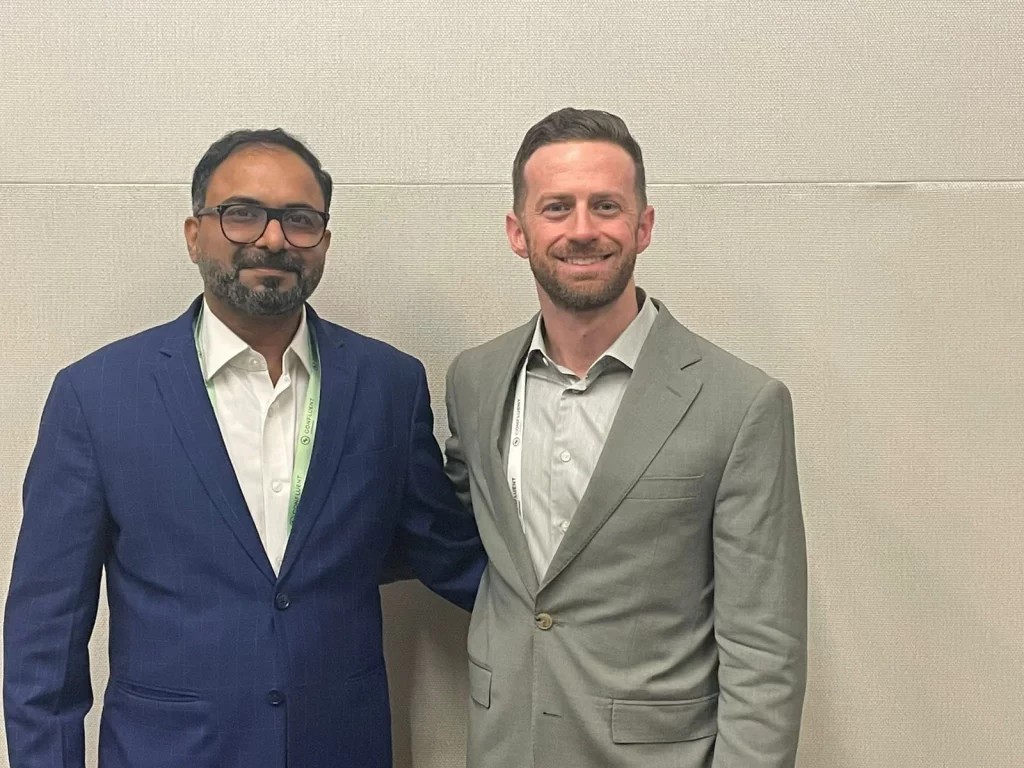
Andrew Sellers, VP – Technology Strategy and Enablement, and Rubal Sahni, AVP – India and Emerging Markets, Confluent, discuss why data streaming is becoming a foundational layer for real-time agility, AI, and enterprise transformation.
Confluent, the California-based data streaming pioneer built around Apache Kafka, is at the forefront of helping enterprises rethink how they harness real-time data. Originally developed as a distributed event streaming backbone, Kafka has evolved from a messaging system into a foundational layer for modern, event-driven architectures—enabling organizations to continuously capture, move, and process data as it is generated.
At a time when CIOs are under pressure to scale AI beyond pilots, deliver real-time experiences, and prove tangible ROI, the need for reliable, governed, and continuously available data has become critical. Platforms like Confluent are extending Kafka’s capabilities into a full-fledged data streaming ecosystem, allowing enterprises to move beyond batch processing toward always-on, intelligent operations.
On the sidelines of the Confluent Data Streaming World Tour in Mumbai, Andrew Sellers, VP – Technology Strategy and Enablement, and Rubal Sahni, AVP – India and Emerging Markets, spoke with CIO&Leader about why data streaming is no longer just about pipelines, but a foundational layer for agility, AI, and real-time enterprise transformation.
CIO&Leader: Data streaming is often seen as just pipelines. What’s changing in how enterprises should think about it?
Andrew Sellers: That view is rapidly evolving. Data streaming is no longer just about moving data in real time; it’s about re-architecting how enterprises operate.
“Data streaming is no longer about pipelines, it’s about re-architecting how enterprises operate.”
Having served as a CTO twice, what drew me to streaming was its ability to decouple teams, systems, and technologies. Beyond real-time movement, it enables continuous data reuse, accelerating time to market for new applications. Once data is produced, it can be leveraged repeatedly, driving faster innovation. Digital-native firms, especially in India, build this in from the start, while legacy enterprises use it to break silos and modernize data into lakes.
For CIOs, the true value of streaming isn’t cost efficiency, it’s speed, agility, and the ability to innovate continuously.
For CIOs and CTOs, the real value isn’t cost efficiency—it’s speed and agility. When data is discoverable, contextualized, and trusted, building new applications becomes significantly faster. In most modern use cases, the bottleneck isn’t model development but accessing reliable data inputs. Streaming addresses this foundational challenge, enabling innovation at scale.
CIO&Leader: How does this play out differently for startups versus large enterprises?
Andrew Sellers: The contrast is quite stark. Digital-native startups have the advantage of starting from a clean slate. They are not constrained by legacy systems, so they can adopt modern architectures—including streaming—from day one. This allows them to move faster and innovate without friction.
Large enterprises, however, typically begin with targeted use cases. These are often centered around:
- Breaking data silos
- Enabling real-time decision-making
- Feeding operational data into analytics platforms
Once they see value in a single use case, something important happens—they develop confidence and operational muscle memory. From there, adoption expands organically across the enterprise.
The most successful transformations don’t start with large, risky bets. They start small, prove value, and then scale. We don’t push large upfront costs. Instead, we let them fall in love with the first use case. Once they see success, they come back for more. Our biggest accounts all started with one use case. Executive buyers really appreciate that approach because they stake their careers on these investments, so small steps build trust
CIO&Leader: We are seeing industries move toward instant experiences, quick commerce, real-time lending, AI-driven decisions. How critical is real-time data in this shift?
Rubal Sahni: It’s absolutely foundational.
If you look at the evolution of technology in business:
- A decade ago, it was an enabler
- Five years ago, it became a competitive advantage
- Today, it is a necessity for survival
Industries are being reshaped by speed of decision-making. Whether it’s delivering products in hours or approving loans in minutes, the expectation is shifting toward immediacy.
This is only possible when systems can: Process data in real time; Make intelligent decisions instantly and continuously adapt based on new information
Streaming acts as the backbone for this shift. Without it, achieving true real-time intelligence at scale is extremely difficult.
CIO&Leader: Despite all the progress, many organizations struggle to move AI from pilot to production. What’s the real bottleneck?
Andrew Sellers: It’s not the models—it’s the data infrastructure. Most organizations already have capable models; the challenge is ensuring the data feeding them is accurate, contextual, secure, and continuously available.
Production AI also demands confidence and control. Enterprises need to understand why a decision was made, whether it can be reproduced, and how it can be audited. Yet many modern AI frameworks prioritize speed over transparency, with a single request triggering multiple opaque processes—making behavior hard to track and costs difficult to manage.
What’s needed is a system that captures the full flow of data and decisions, enabling visibility, traceability, and continuous improvement. Without that, scaling AI remains risky. Building a trusted data environment—where data is observable, auditable, and aligned—is essential to giving AI applications a reliable foundation.
CIO&Leader: Can you illustrate the risks of weak data infrastructure with a real example?
Rubal Sahni: Let me answer this. A recent case highlights this clearly. An OCR system misread Rs 80,000 as Rs 80 lakh due to a formatting issue. The payment was processed instantly, and the error was only discovered days later.
The consequences went beyond financial loss. There were:
- Compliance and taxation complications
- Reputational damage
- Customer trust issues
The bigger problem was the lack of visibility—there was no easy way to trace how the error occurred or prevent it from happening again.
This is where real-time data infrastructure with governance becomes critical. It enables organizations to detect anomalies instantly, trace root causes, and enforce safeguards before issues escalate.
CIO&Leader: What are the most common mistakes enterprises make when scaling data streaming platforms like Kafka?
Andrew Sellers: One of the biggest misconceptions is that open-source solutions are inherently “free.” They come with significant operational complexity.
One of the biggest misconceptions is that open-source solutions are inherently free.
Enterprises often struggle with capacity planning. They are either:
- Over-provision for peak workloads, leading to high costs
- Under-provision, resulting in outages and performance issues
Another challenge lies in architectural decisions, such as partitioning, which can be difficult to reverse once implemented. What organizations need is an approach that abstracts this complexity—allowing them to scale dynamically, optimize costs, and maintain reliability without deep operational overhead. More broadly, the shift is from treating streaming as a tool to treating it as a platform, with integrated capabilities around processing, connectivity, and governance.
CIO&Leader: What partitioning issues do startups and large enterprises face differently with Kafka?
Andrew Sellers: Partitioning decisions are hard. You must define partitions early, but adding partitions later breaks ordering guarantees. Startups and large enterprises both struggle: startups often don’t anticipate scaling needs, while large enterprises must plan for peak workloads. Our tools help them balance this—ensuring flexibility, scaling as needed, and maintaining high availability.
CIO&Leader: Why is data governance a blind spot for many enterprises scaling AI?
Andrew Sellers: Data governance boils down to metadata creation, but developers don’t like writing metadata, they prefer to move fast. Yet, governance depends on metadata. AI can help by automating schema induction, it looks at samples and suggests metadata, which developers can quickly validate. This is critical because AI governance depends on strong data governance. If you don’t govern data, you can’t govern AI.
CIO&Leader: Finally, what’s your view on Agentic AI—are we still early, or is it already taking shape?
Andrew Sellers and Rubal Sahni: It’s already taking shape, and faster than many expected.
Six to eight months ago, most enterprises were experimenting with proofs of concept. Today, a growing number are running agentic systems in production.
Agentic AI exists on a spectrum—from structured automation to more autonomous, decision-making systems. What’s changing is that these systems are now being deployed in real business workflows.
However, their success depends heavily on the underlying data infrastructure. Without real-time, governed, and traceable data, agentic systems can quickly become unpredictable. So, while the momentum is real, the organizations that will succeed are the ones that invest not just in AI models, but in the data foundations that make AI reliable at scale.