
Today, when sport is being commercialised rapidly, intellectual property is no longer a formality for a legal housekeeping process. It has evolved into a practical operational risk.
In contemporary sports, intellectual property is now an inventory that is manufactured, licensed, marketed, clipped, copied, counterfeited, mimicked, packaged, and monetized instantaneously. Nevertheless, many organisations continue to guard their intellectual property as a slow-moving legal problem, rather than a swift economic disaster.
The knee-jerk reaction in the sports sector continues to be the call to the lawyer after an issue emerges. This alone is often not enough, as most of the value is lost before the file arrives on the lawyer’s desk. Thus, the question in the boardroom is no longer whether rights are registered and the contracts are enforceable, but it is whether the organisation can identify threats in advance, react quickly, and protect the value of its IP before any negative impact reflects on its financial statements.
Are We Asking The Right Question?
For many years, sports executives have defined IP through the prism of legal protection. The focus has been on ownership, registration, enforcement, and remedies. While these remain fundamental issues for the management of IP, they do not encompass the entire commercial reality of the sports business in a digital marketplace.
The most common examples of failure arise from upstream behaviours. They occur when no one is monitoring marketplace activities in real-time, when impersonation accounts are spinning out of control faster than the reaction; when marketplace listings, betting references, highlight clips, logo misuse, grey market products, and unauthorised data products are treated as isolated instances rather than signals in a larger landscape of risk.
In other words, the essential issue is seldom that of ownership. Rather, it is that of operational transparency.
MAPS: The Real Blueprint
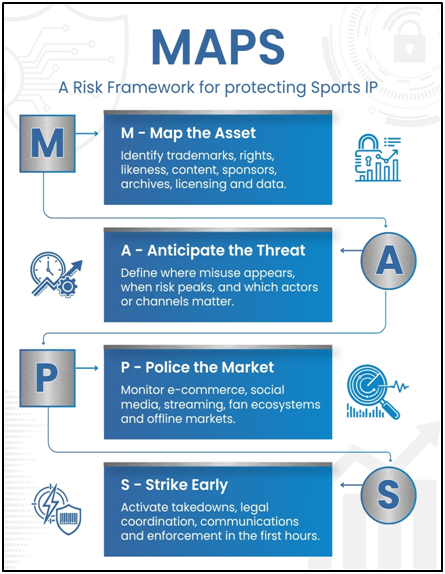
Every sport requires a working framework that can be deployed by decision-makers, investors, and intellectual property owners. This is best achieved through what is called the MAPS concept.
The key benefit of this concept is that it shifts focus away from mere regulatory compliance and towards decision-making discipline. It recognises the dynamic nature of intellectual property issues in sport. Such issues come up in spates before matches, transfers, sponsorship announcements, merchandising campaigns, and world championships. A protection regime designed for annual legal reviews does not fit such an environment.
Why Does the India-Gulf Linkage Matter?
What makes the India-Gulf link relevant is not its international aspect but rather its relevance to the new commercial route in sport.
India has become too commercially important to be referred to as an emerging market. The Economic Times reports that India’s sports industry was valued at Rs 18,864 crore ($2.1 billion) and cricket accounted for approximately 89% of this revenue, while the IPL remains the main driver of commercial development. The sheer size and value of the Indian sports market drastically changes the IP picture, and with an increasing emphasis being placed from a commercial standpoint through media rights, sponsorship, endorsement, and digital advertising, IP is now the primary monetisation layer and no longer exists merely as a peripheral legal structure.
Similarly, the Gulf region is not only hosting sports, but they are also creating an investment thesis around it. An Official Saudi Press Agency report discussing the opening of the Sports Investment Forum 2026 in Riyadh defines the seriousness with which politicians and investors are approaching sports in the Gulf. Additionally, in many other countries throughout the Gulf, countries are utilising sport to attract capital, diversify their economy, enhance tourism, develop soft power, and create an internationally recognised platform.
When combined, these areas become part of a strategic corridor. India is a demand-and-content hub. The Gulf is rapidly becoming a capital-and-event destination. However, this also implies that counterfeiting, dilution, and misappropriation can occur in the same way. This is the reason why an India-Gulf perspective is so important. It demonstrates that the future of sports intellectual property risk management isn’t going to be limited to larger lawsuits. The future lies in cross-border velocity.
From IP Protection to IP Asset Management
This evolution demands maturity from the boards, promoters, federations, and sponsors in question. Mature organizations already manage their physical assets via security and their digital assets via cybersecurity protocols. However, many of them still view IP protection as a contractual issue, which only becomes relevant once there is an infringement.
In the sporting world, IP is more than just the logo on the shirt. IP is the premium in sponsorship. IP is the scarcity of rights. IP is the trust in official routes. IP is the authenticity in merchandising. IP is the exclusivity in live attendance. After all, once the value has been compromised, legal sanctions can be imposed upon the culprit, but they cannot always revive the asset.
The entities that will succeed during the next phase of sports expansion will be the ones who ask themselves: have they mapped their asset? Have they anticipated their risk? Are they policing their market? Can they intervene in time to make a difference?
These are not exclusively legal considerations. These are leadership considerations.
The New Standard for Sports IP
Intellectual property in sports used to be just a specialist area for lawyers and an item to be discussed whenever there was litigation. However, now Intellectual property is going to play an important role in defining what an organisation owns and, ultimately, who captures what it owns.
World Intellectual Property Day ought to serve more than as a reminder to either secure your intellectual property or tidy up your contracts. It should be a call to the sports industry to adjust its business practices. The winners will be those who are able to protect this asset while the game is being played.
–Authored by Sagarika Chakraborty, CEO, India & Gulf, IIRIS Consulting
About the Author
Sagarika Chakraborty is CEO, India & Gulf at IIRIS Consulting, a risk advisory and intelligence firm with operations across the globe. She specialises in fraud investigations, forensic practice, legal strategy, and digital risk.