
After learning hardware skills at a cricket-tech startup, a Grade XII student built an AI-powered sensor for tennis rackets—and then channelled that expertise into an initiative helping other students access industry-recognised technical courses.
When cricketer Shikhar Dhawan endorsed StanceBeam Striker, a sensor that clips onto a cricket bat and turns net sessions into data on bat speed, power and shot efficiency, Priyansh Agarwal saw a technology gap in another sport he knew well: tennis.
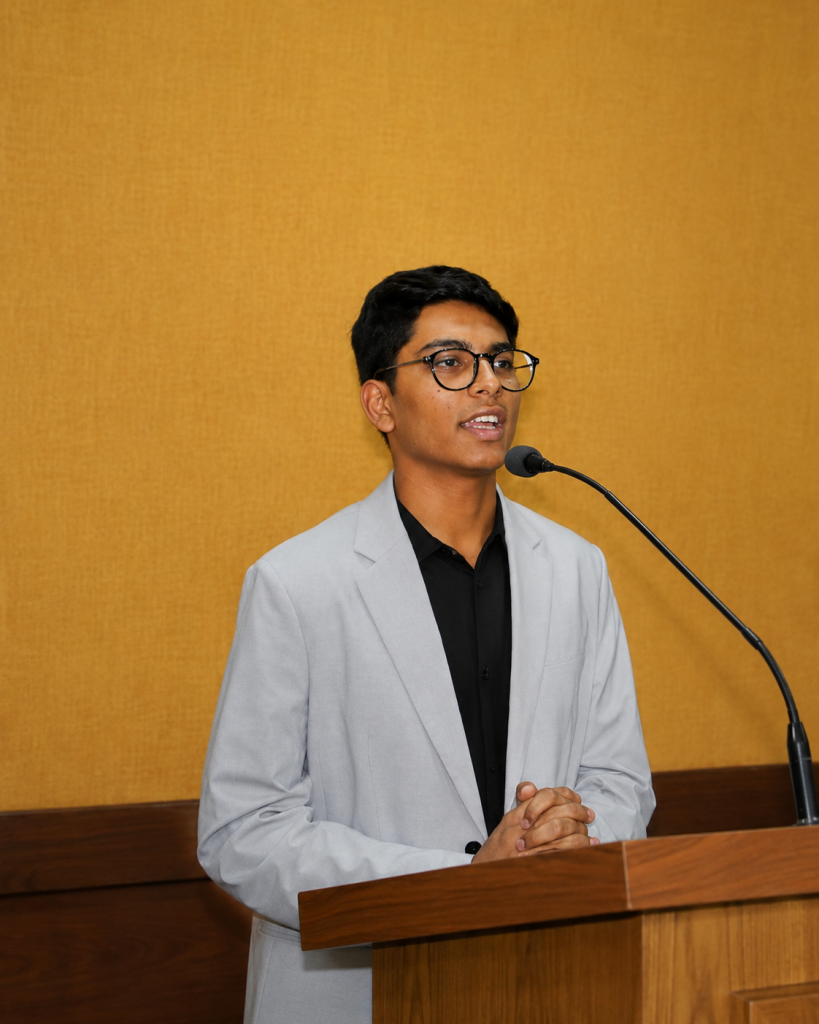
From a Cricket Sensor to a Tennis Innovation
Agarwal, a Grade XII student and national-level tennis player at DPS Gurugram Sector 45, wanted to bring the same data-driven approach to tennis. “I decided I would make something equivalent to the bat sensor for tennis,” he says.
As a competitive player, Agarwal had experienced the limitations of traditional coaching firsthand. Access to academies, personal coaches and sophisticated performance analysis can be expensive, leaving many players without the kind of data that professional athletes increasingly use to improve performance.
His idea was to make that technology more accessible.
Agarwal developed the technical foundation for the project during an internship at StanceBeam, the company behind the cricket-bat sensor. He learnt hands-on skills in electronics, embedded systems and sensor integration and then began adapting the technology for tennis.
The result was TennEdge, a compact sensor designed to capture and analyse a player’s performance.
The Hardware Challenge: Keep the Data, Lose the Weight
The biggest engineering challenge was not collecting the data but figuring out where to place the sensor.
A cricket bat can accommodate additional hardware without dramatically changing its handling. A tennis racket is far less forgiving. Even a small increase in weight can affect balance, swing and player comfort.
Early versions of TennEdge were mounted directly on the racket, but Agarwal quickly found that the additional weight compromised the playing experience.
“One simple thing caused me trouble, and that was mounting the sensor on the racket, which was making the racquet too heavy and uncomfortable to even play,” he says.
He experimented with multiple configurations, including mounting the sensor on the strings. The eventual solution was deceptively simple: move the hardware away from the racket altogether.
Agarwal integrated the sensor into the wristband players already wear on court.
“There was no deflection in accuracy, and no compromise on comfort was made,” he says.
The approach illustrates an important principle in wearable and sports technology: the best technology is not necessarily the most visible. It is technology that can capture useful data without interfering with how the user performs.
Turning Player Movement into Data
TennEdge is designed to capture performance metrics such as swing speed, shot accuracy, power and spin. The sensor transmits the data over Bluetooth to a companion application, allowing players to see performance information that would otherwise require a coach or specialised training setup.
For Agarwal, the objective is not simply to build another sports gadget. It is to use sensors and data analytics to democratise access to performance feedback.
A player training without a personal coach can potentially use the data to identify weaknesses, track improvements and make more informed adjustments to technique.
Agarwal is currently piloting TennEdge with tennis academies. The longer-term plan is to make the product available to individual players through e-commerce and retail, while also offering it in bulk to academies and institutions.
From Building a Sensor to Building Skills
The TennEdge project also highlighted a different technology challenge for Agarwal: learning how to build the hardware in the first place.
Much of his understanding of embedded systems, electronics and motion-sensor integration came through practical exposure rather than conventional classroom learning.
That experience eventually led him to a larger question: if hands-on access to technology can enable a school student to build a product, how many other students could benefit from similar exposure?
The answer became Skill Bridge, an initiative Agarwal launched in partnership with the Tamil Nadu government’s Naan Mudhalvan scheme, which trains roughly one million students annually in industry-ready skills.
Taking Hardware Skills Beyond the Classroom
Through Skill Bridge, college and high-school students are enrolled in electronics courses covering areas such as those that helped Agarwal develop TennEdge. The programme focuses on practical, industry-oriented training, with an emphasis on making students placement-ready.
Skill Bridge also aims to connect trained students with electronics companies, creating a pathway from technical learning to employment.
The initiative reflects a broader shift in how technology skills are being acquired. For emerging technologies, classroom theory alone is often insufficient. Students increasingly need access to hardware, development environments, real-world projects and industry exposure to understand how technology works outside a textbook.
For Agarwal, that journey started with a simple question about why tennis did not have the kind of performance technology already available in cricket.
It has since evolved into two parallel pursuits: building technology for athletes and building technology skills for the next generation of students.
– Ajay Verma is a Chandigarh-based independent author and researcher. He has previously worked with leading consulting firms and writes on technology, business, and public policy.