
As AI reshapes industries at breakneck speed, CSIR-NPL Director Prof. Venu Gopal Achanta makes the case that metrology — the 150-year-old science of measurement — holds the key to certifying, benchmarking, and building trust in AI systems.
As artificial intelligence reshapes every industry at breakneck speed, one question often goes unanswered: who verifies that AI works the way it claims? Prof. Venu Gopal Achanta, Director of CSIR-National Physical Laboratory (CSIR-NPL), believes metrology, the science of measurement, holds the answer.
In a recent conversation with ET Edge CIO&Leader, he draws parallels between India’s 150-year-old metrology tradition and the emerging need for AI certification, benchmarking, and traceability. He unpacks why quantum sensors, not quantum computing, deserve India’s immediate attention, what the German and American models offer as blueprints, and why semiconductors should top India’s technology priority list over the next decade.
Achanta argues that India’s path to becoming a technology powerhouse by 2047 runs through its most invisible science: precision measurement. Backing that vision is a sizeable institution: CSIR-NPL runs on a team of around 800 people — about 145 scientists, more than 150 technical staff, and about 100 people in administration, finance, and support roles, plus many contractual staff and students, including roughly 200 industry-sponsored PhD scholars.
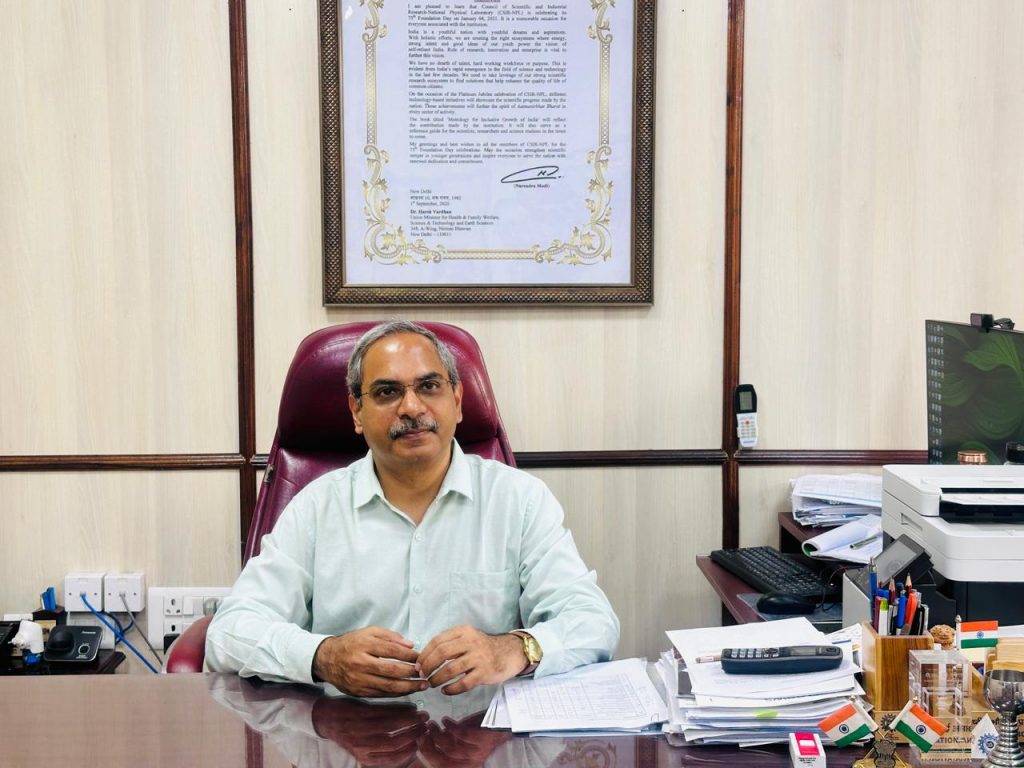
Director of CSIR-National Physical Laboratory (CSIR-NPL)
Excerpts from the interaction:
ET Edge: Today, NPL is the custodian of India’s measurement standards. In an AI-first world, could NPL play a similar role for trustworthy AI through standards, benchmarking, or certifications? Could India eventually require an AI equivalent of calibration for critical applications?
Prof. Venu Gopal Achanta: This is a very important question, and it is pertinent for the future. In metrology, we have the seven SI units, and these, along with derived units, underpin every measurement. Scientific metrology, which measures these seven SI units as precisely as possible, remains important even after 150 years, and going forward, AI will both influence and require metrology.
AI’s implications depend on where it’s applied. In biomedical applications, for instance, ethical issues arise, how do we distinguish between generative AI, data analysis, and other approaches? These are things we need to address.
In the metrology community, we’re working on digital transformation. At the CIPM level, there’s a body called Forum MD, where countries work together to digitise how we handle data, digitise measurements, and bring AI into data analysis and other applications. We are using AI while also building metrology models to ensure the data source is reliable, for AI, one of the most critical things is ensuring the integrity of the source.
So we are working on a network of sensors and the metrology behind them. Calibration, testing, and certification of various kinds of sensors is something we’re working on together as a metrology community.
ET Edge: AI is evolving so fast that it’s reshaping how everything works, making responsible AI an urgent priority for CTOs and innovation leaders at large enterprises. Where do we need to invest more now to ensure students and researchers are equipped to build trustworthy AI models, and how do you see the market evolving for responsible AI from here?
Prof. Venu Gopal Achanta: I’ll point to the German model. The German government mandated PTB Germany, their national metrology institute, equivalent to NPL India — to develop digital transformation models, starting with certification, that would become a standard across all industries. They take use cases from each industry and implement a common base platform on which industry-specific verticals are built. That mandate came from the government side.
Unfortunately, metrology is still not very pervasive here. Quality is something the Prime Minister keeps emphasising — our products should be seen as high-quality, high-value products globally. Metrology is the backbone of that; global acceptance of products comes from the certification metrology institutes provide.
The MRA convention dates back to 1875, and under the CIPM Mutual Recognition Agreement, 92 countries have signed on. A certificate issued by NPL India is accepted in 92 countries worldwide.
We need to strengthen our metrology activities by bringing in industry, R&D institutions, and universities. NIST in the US is a good example — they fund people from universities to come work in their labs, develop new techniques and methods, and sometimes translate them into technologies. We need that kind of platform. We still need dedicated funding for metrology.
The clearer focus should be on quantum sensors, not on the buzz around quantum computing. Let the quantum computers come when they come.
ET Edge: Apart from funding, do you think India has the talent required to become a key powerhouse in setting these standards?
Prof. Venu Gopal Achanta: We have the workforce in abundance, but government labs need to strengthen their staffing — many posts have been reduced over the years. These are highly skilled jobs; people train and upgrade their skills over decades to become master metrologists. India has talent, but its government labs need stronger staffing — not just scientists, but technical officers and technical assistants too. We have a talent pool within the country. We need to use it.
ET Edge: What are some of the invisible scientific capabilities — whether in measurement science, quantum, or advanced instrumentation — that India should invest in to lead the next wave of innovation?
Prof. Venu Gopal Achanta: Quantum is one area where we’re already doing well. It spans quantum computing, quantum communication, quantum sensors in metrology, and quantum materials — and traditionally, we’re very strong in materials.
Quantum computing is different, and only a few groups are working on it, whether superconducting or neutral-atom-based, under the National Quantum Mission. But the low-hanging fruit is quantum sensors, where sensitivity can be much higher and precision can reach very high levels for different applications. The clearer focus should be on quantum sensors, not on the buzz around quantum computing. Let the quantum computers come when they come — before that, AI, high-performance computing, and the modest quantum computing resources we have today should be pooled together, and we should develop utilities around them.
For quantum sensors, we have strong facilities at CSIR-NPL. Over the last four to five years, we’ve invested in them — we developed and demonstrated one of India’s first magnetometers here and transferred it to a startup for strategic applications. We’re now transferring technologies to industry across the quantum sensors vertical: magnetic field, electric field, RF field sensing, single-photon sources, and quantum random number generators. This includes calibration and certification facilities for all of these.
ET Edge Insights: Which countries are we transferring our knowledge to, and with whom are we closely aligning as a global powerhouse?
Prof. Venu Gopal Achanta: This is tricky, because many countries are closing their doors, they don’t want to transfer knowledge or share cutting-edge technologies. In metrology, there’s a body called the National Metrology Institutes of Quantum (NMIQ), which includes the US, Japan, Australia, Canada, Germany, and the UK. These countries want to develop standards for these futuristic technologies among themselves, and that’s where we’re working to be part of the conversation.
We now have about 150 quantum startups in the country, including 40-plus in the Amaravati Quantum Valley, and we’re working with them. The idea is to set up the primary national standard here at NPL India and compare our measurement facilities with those worldwide, so that a certificate issued by NPL is accepted globally. We also want to extend this to Amaravati and other places, so certification and standards facilities are available for startups there too.
We still collaborate closely with PTB Germany — recently on energy and renewables, whether hydrogen or solar. Their president visited recently, and we signed an MOU focused on energy materials, the energy sector, metallurgy, and fossil energy.
R&D institutions so far have focused on publications; now we should focus on translating that knowledge and know-how into industry… so innovation becomes influence.
ET Edge Insights: Which emerging technology or scientific discipline do you believe India is significantly under-investing in today, despite its potential to shape our future?
Prof. Venu Gopal Achanta: Quantum has considerable visible funding, but translation isn’t happening — only a few groups get picked up and funded. Many industries get funds based on idea alone. For the past three years, I’ve been trying to set up standards here, and we haven’t received dedicated funding for it.
People need to focus on metrology. Scientific leaders should support it, because it will eventually be essential for every product coming out of India. Unless we provide metrology support, startups and industry will have to go abroad to certify or characterise their devices.
We do have an AI mission, a quantum mission, a semiconductor mission, and a high-performance computing mission — this government is willing to invest heavily in each of these. But we also need to focus on the supporting metrology behind them.
ET Edge Insights: Government research institutions are often seen as centres of scientific excellence. How can institutions like NPL and CSIR collaborate more effectively with startups and industry to accelerate India’s deep-tech ecosystem?
Prof. Venu Gopal Achanta: I am part of the Quantum Valley initiative, and we are making use of that.We are organising a hackathon there, because we need more interaction. It’s a big country, unlike a European country like Germany or Italy, one of our states is like a continent in scale, so whatever we do, however much publicity we give it, there’s always more need.
Minister Dr Jitendra Singh proposed the idea of “One Week, One Lab,” we bring in stakeholders, students, and industry, one group each day. The resources needed for this are huge.
There is also an ongoing sense of competition globally, the US has dominated so far, but the Chinese presence in this space has grown quickly, and it’s still evolving; we don’t yet know which approach will be most widely accepted. Industry’s caution may also stem from the continued need for manual verification. Generative AI, NLP, and similar technologies are advancing quickly, but at this stage I still take it with a pinch of salt — I would still want to check whether what it’s producing is right.
ET Edge: If India had to place one major technology bet over the next decade, AI, quantum, semiconductors, or scientific infrastructure, which would you prioritise, and why?
Prof. Venu Gopal Achanta: Semiconductors, first and foremost, because semiconductor technologies drive many of these other fields, the fabrication facilities built for semiconductor technology are already helping the quantum world today. Let’s invest in semiconductor technologies first and then translate that investment to other areas.
Quantum should be the second priority, we need to be self-sufficient there and not simply buy these capabilities from others. Semiconductor technology requires significant investment in scientific infrastructure, which is largely in place in the country already but needs expansion. From a government perspective, we have a high GDP, but the population we’re dividing it across is large, so priorities matter.
I would prioritise semiconductors and related technologies, then translate that into quantum. AI will follow, because to me AI is still an elite resource, but it will eventually span every vertical.
We should aim to cut our imports of high-tech equipment by 70–80 per cent, and make high-end scientific equipment ourselves, in India.
ET Edge: As we look toward Viksit Bharat 2047, what would define success for India as a technology nation, not just in innovation, but in scientific leadership and influence?
Prof. Venu Gopal Achanta: Coming from a metrology institute, I have to say: metrology. In any top economy, metrology is directly linked to economic strength, the two go hand in hand. Quality depends on how well we characterise and certify our own equipment, and metrology underpins whatever comes next, including defence.
The key shift is translation. R&D institutions so far have focused on publications; now we should focus on translating that knowledge and know-how into industry, that’s the government’s push too. We should work toward that until 2047, so innovation becomes influence. We should aim to cut our imports of high-tech equipment by 70–80 per cent, and make high-end scientific equipment ourselves, in India.
ET Edge: In terms of tech-focused priorities for your organisation over the next two to three years, could you share some of the top areas of focus?
Prof. Venu Gopal Achanta: The seven base SI units remain the starting point for everything we do.
Over the last five years, we’ve expanded our scope to include traditional medicine. How do we bring Ayush and Siddha medicine under the SI system of metrology? Some of these traditional measures are still imprecise, a “pinch” of an ingredient, for instance, so we are working with the Ministry of AYUSH, Siddha, and our sister labs to develop phytochemical standards and certified reference materials within the country. These will be the standards against which the purity of these medicines is checked, helping harmonise the entire traditional medicine ecosystem.
On the renewable energy side: about four years ago, we asked what challenges we as metrologists should address. One of the biggest is grid stability. There are more than 10,000 phasor measurement units across the grid, measuring current, voltage, and phase over time to monitor how a fluctuation at one location affects another. Precise time-stamping is essential for this, so we needed to ensure all these units were calibrated and reporting consistent numbers. We now have a robust system where every PMU in the country is traceable to the NPL facility.
The government is also targeting 50 gigawatts of solar installation per year. A 1 per cent error in estimating a solar panel’s efficiency translates to roughly a billion-dollar difference in investment, so we need to measure the quantum efficiency of solar cells precisely, we’ve set up a facility for that.
Looking 15–20 years ahead, these solar panels will become waste. Recycling efforts so far have focused on extracting precious metals, silver, gold, platinum plus aluminium frames, glass, and epoxy. We asked what happens to the silicon itself, and we’ve developed a process to recycle and reuse it.
All of this reflects the government’s priorities and our effort to move from innovation to impact in nation-building. Quantum is another area where we’re contributing in the same way.
ET Edge: Are there any internal AI tools you are developing to enhance your research capabilities and ensure researchers across the ecosystem benefit from the knowledge generated?
Prof. Venu Gopal Achanta: We do mostly AI and machine learning models. One recent example, done with a student, involved Jantar Mantar. These yantras were built in the 1700s, so they’re over 200 years old, and we wanted to understand their performance. The student spent five days manually measuring and recording data, then comparing it against NTP (atomic clock time). We found that once you correct for Earth’s rotation and other effects, the instruments perform as expected, with a best resolution of two seconds.
For that, we needed to build models. Indian Standard Time is based on a bank of atomic clocks, each with its own uncertainty and fluctuation that varies through the day, so we take an ensemble average across all of them, and we are developing AI models to improve the accuracy and sensitivity of that averaging.
We should be proud that of the roughly 400 optical clocks worldwide contributing to global time, what used to be called GMT and is now UTC, India’s clocks have the sixth-highest weightage in the world. It’s one of the best contributions we make.