
How Aahana Bhola Is Using Technology, Data and Policy to Rethink Prison Rehabilitation
Prison rehabilitation is rarely discussed through the lens of technology, data or innovation. Yet for Aahana Bhola, a Grade 12 student at the American Embassy School, New Delhi, these became the starting points for exploring how technology and evidence-based thinking could contribute to creating better pathways for rehabilitation.
Her journey began with a machine-learning project.
Aahana had developed a tool to understand what makes crowdfunding campaigns successful. Rather than keeping the project within the boundaries of an academic exercise, she looked for a real-world application. This led her to India Vision Foundation, which works with incarcerated and recently released women.
Using insights from her machine-learning model, Aahana developed a fundraising campaign that raised Rs 72,000 to support hygiene kits for incarcerated and recently released women.
But the experience soon evolved beyond fundraising.
It prompted a deeper question: What does meaningful rehabilitation look like, and how can technology, education and evidence help make it more effective?
From Technology to Evidence
Education quickly emerged as an area of particular interest.
Aahana began exploring how education could support people inside prisons—not merely through literacy or qualifications, but by helping build confidence, emotional resilience, skills and a sense of purpose.
Working with India Vision Foundation, she studied its Adult Literacy, IGNOU/NIOS and prison library programmes, gathering responses from 128 incarcerated individuals across correctional facilities in Faridabad and Gautam Buddha Nagar.
The data offered a broader perspective on the role of education in rehabilitation.
Participants reported increased self-confidence, emotional resilience and a renewed sense of purpose. At the same time, Aahana’s analysis identified differences in the educational support and programme experiences available across the two prisons.
The findings reinforced an important principle: technology and data can reveal patterns, but meaningful change requires understanding the human experiences behind those patterns.
The study has since been accepted for publication in the Journal of Advanced Research in Social Sciences.
From Research to Policy
The research also surfaced a larger systems challenge.
If education can contribute meaningfully to rehabilitation, access to it should not depend significantly on which prison an individual happens to be housed in.
That question took Aahana from research into policy.
She began examining how minimum educational standards, dedicated funding, trained educators, vocational and digital learning, continuity of education following transfer or release, and stronger measurement of outcomes could make prison education more consistent.
This marked an important transition in her thinking—from understanding a problem to considering how systems could be redesigned to address it.
For Aahana, technology was no longer simply a tool. It became part of a broader framework of evidence, measurement, access and scalable social impact.
Technology Meets the Human Story
In July 2026, Aahana’s work with India Vision Foundation took another turn.
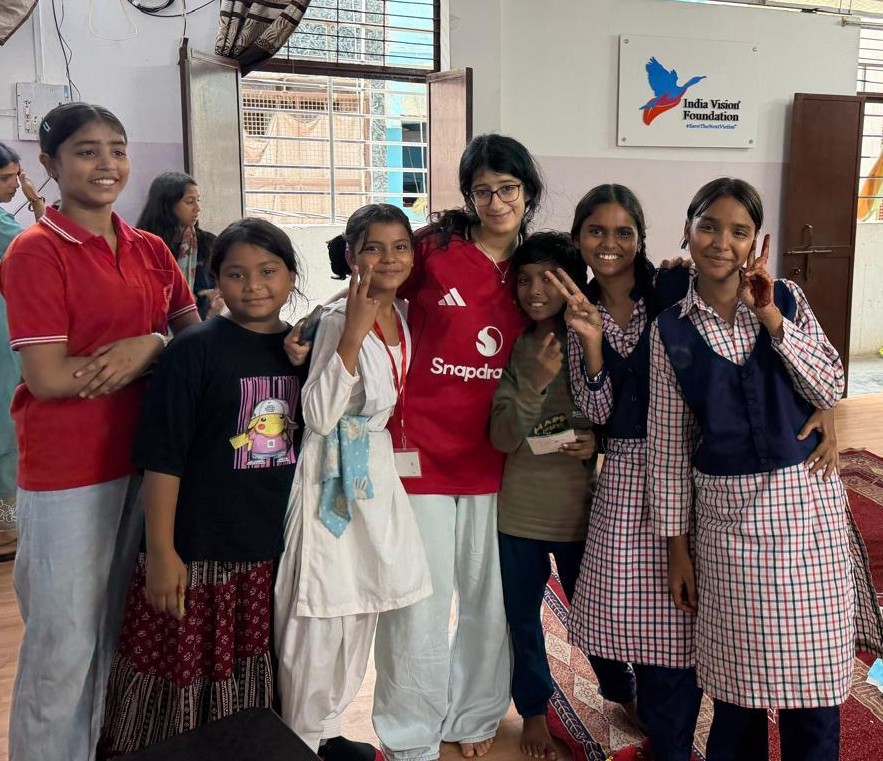
She conducted four creative workshops with 80 children affected by parental incarceration at an India Vision Foundation centre.
Over four days, the children created bookmarks, birthday cards, Rakhis and increasingly intricate quilling pieces, including butterflies, koi fish, a map of India and even the India Vision Foundation logo.
For Aahana, the experience provided a perspective that data and research alone could not.
She saw children demonstrating creativity, adaptability and enthusiasm—and some were already discussing how they could continue the activities and teach younger children at the centre.
At the concluding exhibition, their mothers were invited to see the work. Watching the children proudly display what they had created, and seeing that pride reflected on their mothers’ faces, became one of Aahana’s most meaningful experiences.
Before she left, some of the children surprised her with handmade paper flowers and a card.
She had arrived intending to teach them something. Instead, she left with lessons of her own—about openness, communication, gratitude and adaptability.
A Different Definition of Innovation
Looking back, the different elements of Aahana’s journey are closely connected.
Technology gave her an entry point. Data and research helped her understand the problem. Fundraising demonstrated the potential for technology to create immediate impact. Policy helped her think about scale and systemic change. And direct engagement with families brought the human dimension into focus.
That combination reflects a broader idea of innovation—one that goes beyond deploying new technologies.
For Aahana, meaningful innovation is about using technology and evidence to understand problems better, designing systems that can respond to them more effectively, and ensuring that the people affected remain at the centre of the solution.
Her experience also offers a lesson relevant well beyond prison rehabilitation: technology creates the greatest impact when it is connected to a real human problem and supported by evidence, empathy and the willingness to rethink existing systems.
For Aahana, a second chance therefore means more than release from prison.
It means education, dignity, opportunity—and the willingness to see a person not simply through the circumstances that brought them into the system, but through the possibilities that remain ahead.