
Insurance, healthcare, and fintech rarely share the same rulebook, let alone the same regulatory clock, currency or compliance regime across 40-plus countries. Yet that is precisely the terrain Ebix Technologies navigates daily, running exchange infrastructure that must be simultaneously local in execution and global in reach. In this conversation, Gagan Sethi, CEO of Ebix Technologies, unpacks the architectural choices that make this possible, from versioned “Product Packs” that isolate regional logic, to multi-agent AI embedded directly inside transaction matching and underwriting rather than bolted on as a chatbot layer. He also addresses where automation is genuinely moving the needle in claims and compliance, and where human judgment remains non-negotiable, even as EbixCash pushes real-time settlement and fraud detection to greater scale.

CEO
Ebix Technologies
CIO&Leader: Ebix operates AI-powered exchanges across insurance, healthcare, and fintech in over 40 countries. Architecturally, what does it take to build a single exchange infrastructure that can serve such fragmented, heavily regulated verticals at global scale?
Gagan Sethi: To build an exchange infrastructure spanning insurance, healthcare, and fintech across 40+ countries, you cannot rely on a rigid monolithic core. The complexity of local regulations, currency structures, and data residency requirements will break standard software architectures. At Ebix, we solve this by separating the common global transaction plane from localised metadata-driven execution layers.
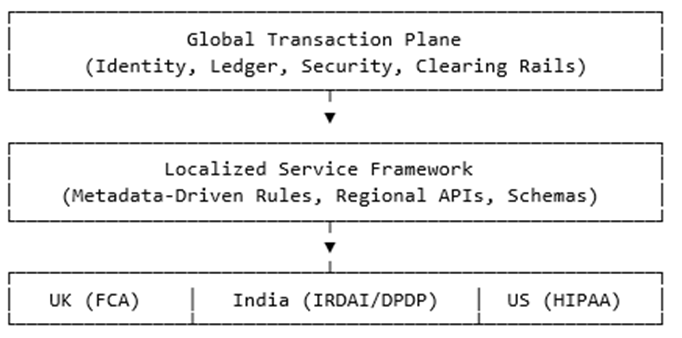
Our architecture relies on a couple of foundational pillars:
- Versioned “Products”: Rather than hardcoding carrier, region, or vertical logic into the engine, we treat them as packaged, versioned configuration files (Product Packs). These packages house the localised risk schemas, validation rules, questionnaire UI layouts, and document templates required for specific countries.
- Normalised Multi-Currency Design: Transactions are stored with their native local currency code alongside a normalised base currency for consolidated global reporting. This preserves local transactional precision while giving parent organisations instant financial visibility.
CIO&Leader: How is AI being embedded into core exchange functions, matching, transacting, and distribution, versus being layered on top as a separate automation tool?
Gagan Sethi: Many systems treat AI as an afterthought, where many are simply putting a chatbot on top of their applications and calling it an “AI-enabled platform.” That approach adds minimal strategic value. At Ebix, we’ve embedded intelligence directly into the critical transaction loop within our ecosystem.
Within the EbixONE AI Platform, AI operates directly inside key processes. A few examples are:

Extraction & Ingestion: Instead of manual data entry for complex transactions, we run high-volume extraction workflows that translate incoming unstructured risk schedules or medical documents into structured schema fields.
- Transaction Matching & Routing: During policy renewals, our multi-agent framework checks client history against current carrier guidelines and highlights risk changes or coverage gaps in real time.
- Real-time Analytics: Our risk analytics engine processes geographic and portfolio data inside the exchange, giving brokers and underwriters visual modelling and risk concentration analysis before a policy is bound.
CIO&Leader: As you modernise legacy insurance and financial systems, what specific technical challenges arise when migrating high-volume, mission-critical transaction workloads to cloud-native, API-driven architectures without disrupting live operations?
Gagan Sethi: Migrating high-volume, mission-critical transactions from database systems built decades ago to microservices and cloud environments is highly complex. Our clients and businesses we serve cannot tolerate service interruptions; a minute of downtime on an exchange impacts distribution and revenue. We address this with a phased approach rather than a single major migration event:
The Transition Engine Pattern: We establish a robust event bridge between the legacy systems and our cloud platforms. This allows both systems to run in parallel, ensuring real-time data synchronisation.
API Brokerage Layer: We wrap legacy business logic with clean, modern REST and GraphQL APIs. Outwardly, clients get modern API-first connectivity, while behind the scenes, we orchestrate communication with older mainframe segments.
Gradual Database Offloading: We selectively migrate read-heavy processes (like policy search and document generation) to write-optimised replica databases in cloud environments. This relieves pressure on mainframes while minimising the impact of database writes.
CIO&Leader: In claims processing, underwriting, and compliance reporting, where is AI-driven automation delivering measurable efficiency gains today, and where are you finding its limitations in high-stakes decisioning?
Gagan Sethi: We measure our AI deployments by their actual impact on operational cycles and accuracy, maintaining clear, intentional guardrails in critical areas.
For instance, in P&C & Health Underwriting | AI-driven extraction reads legacy commercial policies, analyses coverage lines, and suggests structured data mappings. This significantly cuts group benefits setup times; however, complex casualty, tailored commercial lines, and non-standard risks require experienced human underwriters. AI helps compile data, but human judgment remains essential.
In our claims and billing platforms, automated document sorting and indexing have halved incoming ticket processing times; still, claims triage, liability decisions, and reserve allocations are never fully automated. Our workflow maintains “human-in-the-loop” verification steps before binding financial liabilities.
In our Risk compliance solution, AI actively screens Certificates of Insurance (COI) against complex commercial leases to alert users to coverage gaps instantly. Afterwards, any warning or coverage rejection flagged by the AI must present clear reference links showing exactly where the policy doc falls short of the mandate, which the human governs.
CIO&Leader: Given Ebix’s footprint across payments, forex, and cross-border transactions through EbixCash, what technical safeguards are essential to ensure real-time settlement accuracy and fraud prevention at that scale?
Gagan Sethi: Operating cross-border transaction networks like EbixCash demands exceptionally robust architectural controls. As a matter of a few examples –
- Isolated Local Clearing Queues where High-volume transaction streams are separated into isolated queues based on geography. A localised payment gateway issue or regulatory hold in one market never slows down transaction flows in another.
- We feed structural transaction telemetry into streaming detection models. The engine flags out-of-pattern cross-border money flows or repeat micro-transacting behaviours before money settlement begins. As another example, within our custody and wealth platforms, we use deterministic ledgers to verify account balances and confirm security placements before initiating settlement entries.
CIO&Leader: How do you approach data interoperability and standardisation when connecting insurers, banks, brokers, and healthcare providers, many running disparate legacy systems, onto a common exchange platform?
Gagan Sethi: The most persistent bottleneck in fintech and insurtech is the sheer variety of data standards and formats in use. In insurance, it is even more complex than banking transaction standards. This is essentially core Ebix expertise, and we have done it in various ways; a few examples are-

- Canonical Intermediate Models where we avoid building direct translations between every individual system. Instead, we translate all regional and carrier-specific schemas (such as ACORD on the insurance side, HL7/FHIR on the medical side, or custom proprietary text files) into our own standardised intermediate format.
- Mapping Templates. Instead of creating hardcoded parsing rules for every legacy platform, we utilise a flexible schema-mapping engine. This lets technical teams configure translation rules quickly for different carriers and brokers.
- Stateful Validation Desks or data exchanges in the middle, where if an inbound payload has errors (such as missing required fields), the trade or policy stays in a dedicated error-handling queue. The system lets operators correct the data inline without failing the entire transaction run.
CIO&Leader: What AI governance and explainability frameworks does Ebix build into its platforms to meet compliance requirements across healthcare, insurance, and financial services in different regulatory jurisdictions simultaneously?
Gagan Sethi: Maintaining compliance across diverse regulatory bodies like HIPAA and GDPR, alongside organisations like IRDAI or FCA, requires built-in governance structures from day one. For healthcare applications under our Verified Medical AI solution (powered by highly trusted sources like ADAM and Oakstone), we trace clinical advice directly to verified medical literature rather than general LLM generation. We also maintain strict regional data isolation. The AI models processing sensitive health and personally identifiable information (PII) are containerised to run exclusively within distinct local regions. Under no circumstances is clinical or financial data transferred out of region for base model training.
- Lastly, we audit and log every automated match, quote recommendation, and exposure assessment with a complete metadata profile: the original input data, the active system-prompt parameters, the schema configuration version, and the final scoring model code. These are packaged into structured compliance reports to confirm explainable, audit-friendly automated decisions.
CIO&Leader: As InsurTech, FinTech, and HealthTech converge on shared digital infrastructure, what technical or architectural risks come with building such tightly interconnected ecosystems, and how is Ebix designing for resilience against systemic failure?
Gagan Sethi: As fintech, insurtech, and healthtech systems connect more deeply, we face new challenges. A failure in an underlying identity provider or credit validation gateway can quickly trigger issues across downstream networks. Ebix minimises these systemic risks through resilient system design. Our core platforms (such as healthcare eligibility, wealth administration, and travel distribution) operatively interact via modern asynchronous APIs, but run on completely isolated network layers and database stores. An unexpected spike or issue on our travel exchange cannot affect the uptime or performance of our health or wealth systems.
- Our Exchanges rely heavily on APIs and connectivity. So if a partner carrier’s validation API goes offline, our engines don’t block the broker’s screen. Instead, the transaction queue automatically caches request metadata and securely stores the transaction state, processing it as soon as the connection is restored.
- We have also employed advanced API gateways to protect our infrastructure from downstream traffic spikes or automated system loops. If an external partner’s system sends an unusual volume of duplicate calls, our system dynamically isolates that specific route to keep the overall ecosystem safe and functional.