
At the ET Edge CIO&Leader Annual Conference, Dr Murthy Remilla drew on India’s human spaceflight programme to argue that true autonomy was never about removing humans from decisions, but making those decisions more reliable.
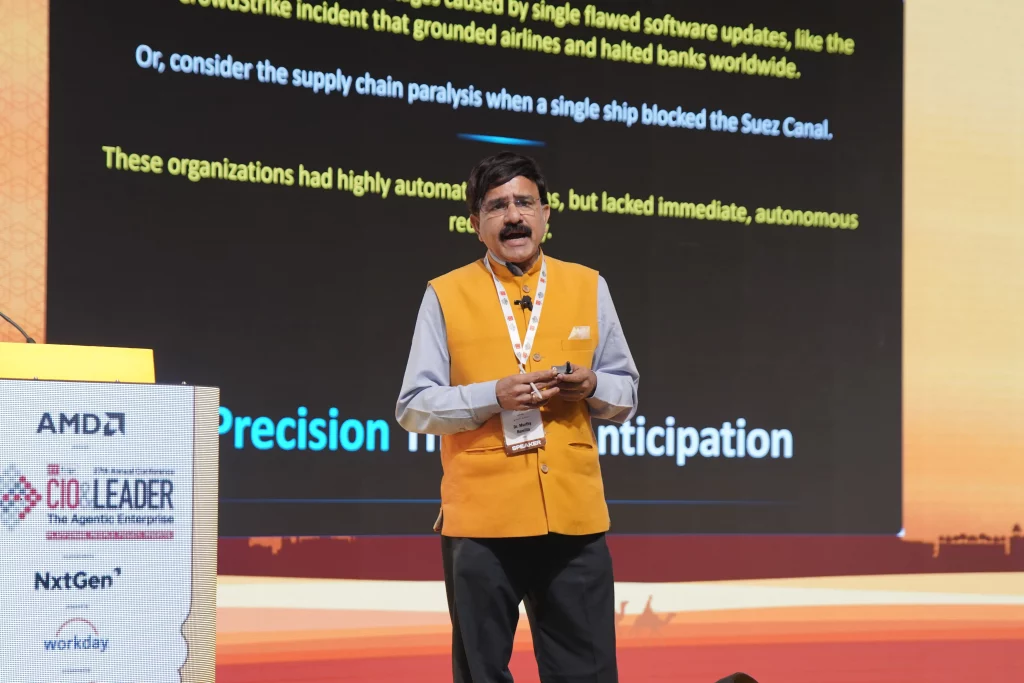
Dr Murthy Remilla, Former Head – Project Management, Human Spaceflight Group at the U R Rao Satellite Centre, ISRO, opened by framing the stakes of his own field in stark terms: when human lives are on the line, the margin for error is effectively zero. Long before “AI” became a mainstream business term, he said, organisations like ISRO were already building intelligent systems capable of sensing, evaluating, and making autonomous decisions in mission-critical situations — even if they never called it AI at the time.
The launch that aborted itself
To ground this, Remilla shared a striking example from a GSLV mission, where an onboard autonomous system aborted the launch at the very last second, having detected conditions that could compromise the mission. It was, he said, a clear demonstration of a system built to make a judgement call under pressure and act on it decisively — a scenario with no room for a second attempt or a human override in the moment. He connected this directly to India’s Gaganyaan programme, noting that unmanned test flights are underway now, with a crewed mission possibly following around 2028, each stage building the confidence needed before humans are put on board.
A lesson for the enterprise
Remilla drew a direct line from this high-stakes environment to the challenges enterprises face today as they adopt AI and autonomous systems. While the scale and consequences differ, he argued, businesses are grappling with a version of the same problem ISRO has spent decades refining: how much can you trust a system to act on its own, and where should human oversight remain non-negotiable. His point to the CIOs in the room was that the technology itself is only part of the story — what matters just as much is understanding the downstream effects of the decisions these systems make.
True autonomy still needs humans
The central idea Remilla returned to was a reframing of what autonomy actually means. “True autonomy does not mean you’re eliminating humans in the loop,” he said, “but it goes beyond humans, and humans are definitely in the loop.” For Remilla, this isn’t a limitation on autonomous systems — it’s the design principle that makes them trustworthy. Autonomy, in his framing, is about enabling systems to make faster, more informed decisions, while ensuring human judgement remains central to accountability and oversight.
Reliability over replacement
Remilla closed by reframing the goal for enterprises building agentic AI: the aim isn’t to remove people from decision-making, but to create systems where human expertise and intelligent machines work together to achieve higher levels of reliability, safety, and performance. It was a message rooted in decades of human spaceflight experience, but one he positioned as directly relevant to any enterprise now handing more decisions to autonomous systems — the real measure of success isn’t how independent the system is, but how much better the outcomes are because humans and machines are working the problem together.