
At ET Edge CIO&Leader Annual Conference, Birlasoft CIO Vinod Sivarama Krishnan says CIOs now own AI accountability, must move past pilots at scale, treat governance as an accelerator, and track “return on tokens” closely.
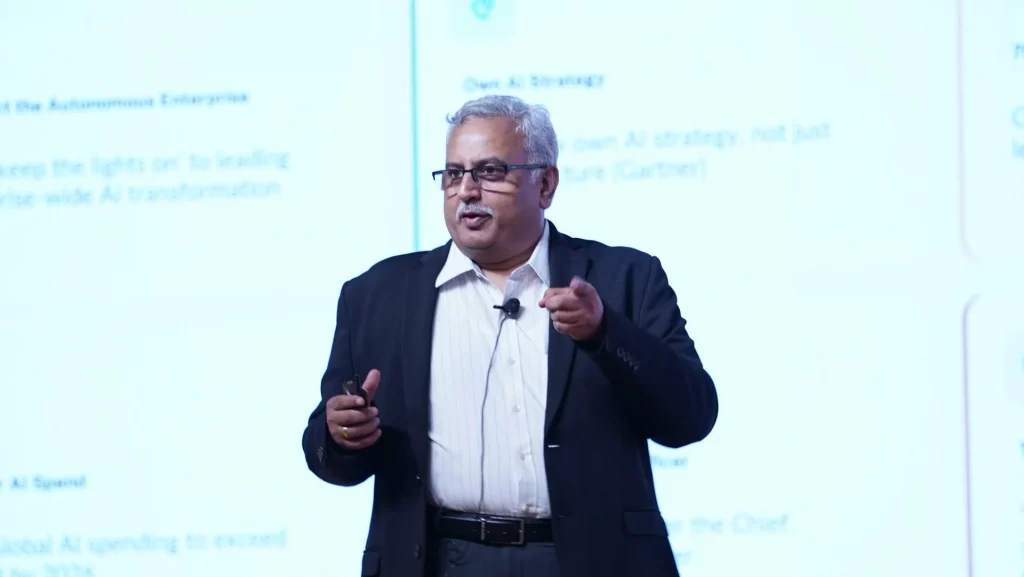
At the 27th ET Edge CIO&Leader Annual Conference in Jaipur, Vinod Sivarama Krishnan, CIO of Birlasoft opened his keynote with a keen observation; the debate over who owns AI within an organisation is effectively settled. After a period of fundamental examination, companies across the board have concluded that accountability for AI rests with the CIO.
His session mapped out that ownership actually demands an end to endless piloting, governance reframed as a growth lever, and a sharper eye on what every AI dollar is returning.
From tool custodian to rail-layer
Krishnan opened by tracing how the CIO’s mandate has shifted since AI entered the enterprise conversation. Early on, there was a debate about whether the CIO was even the right owner for AI initiatives, given how different the technology is from conventional IT deployments.
That debate, he said, has settled.
Organisations have concluded that the person accountable for AI has to be the CIO — not because AI is just another piece of software to procure, but because it now shapes how the company itself operates. Where the CIO’s job was once about evaluating tools, packages, and solutions, it has become about laying down the operational rails the rest of the business must run on. Once those rails are set, the organisation’s processes, decisions, and workflows increase within them.
Shutting down the pilot factory
One of the sharpest observations of Krishnan’s talk was his critique of what he called the “pilot factory”. The pattern of running AI proofs-of-concept that generate excitement but never graduate into production, quietly becoming ghosts in the organisation’s technology roadmap. He argued that the original purpose of a pilot, to demonstrate that a technology could work, no longer holds. AI’s capability is proven; continuing to run pilots purely to test the concept is, in his view, a sign a CIO has not fully committed to the shift. The task now, he said, is dismantling the pilot factory itself and replacing it with structures designed to take ideas to scale.
Governance as an accelerator
Krishnan pushed back on the common framing of governance as a control mechanism that slows AI adoption down. Done well, he said, governance does the opposite — it gives CIOs a working mechanism to know whether a given application or system is functioning as intended, which removes friction rather than creating it.
He concluded his session with a warning grounded in day-to-day CIO reality: dedicated AI budgets remain rare. Most AI spending is still folded into existing technology budgets, and an unexplained 30-40% jump in that line item is likely to draw scrutiny from leadership. That pressure, Krishnan said, is what makes “return on tokens” a metric CIOs can no longer treat as optional — every unit of AI usage now needs a defensible business case behind it.