
Andrew Huang on AI sovereignty, data ownership, and why trusted infrastructure will define the next phase of enterprise AI
As enterprises race to deploy generative AI, attention is shifting from models and applications to a less glamorous but increasingly strategic layer of technology: data infrastructure.
Organizations are discovering that AI success depends not only on algorithms but also on how effectively they can store, govern, protect, and access growing volumes of data. Questions around where data resides, who controls it, and how securely it can be used are rapidly becoming boardroom discussions.
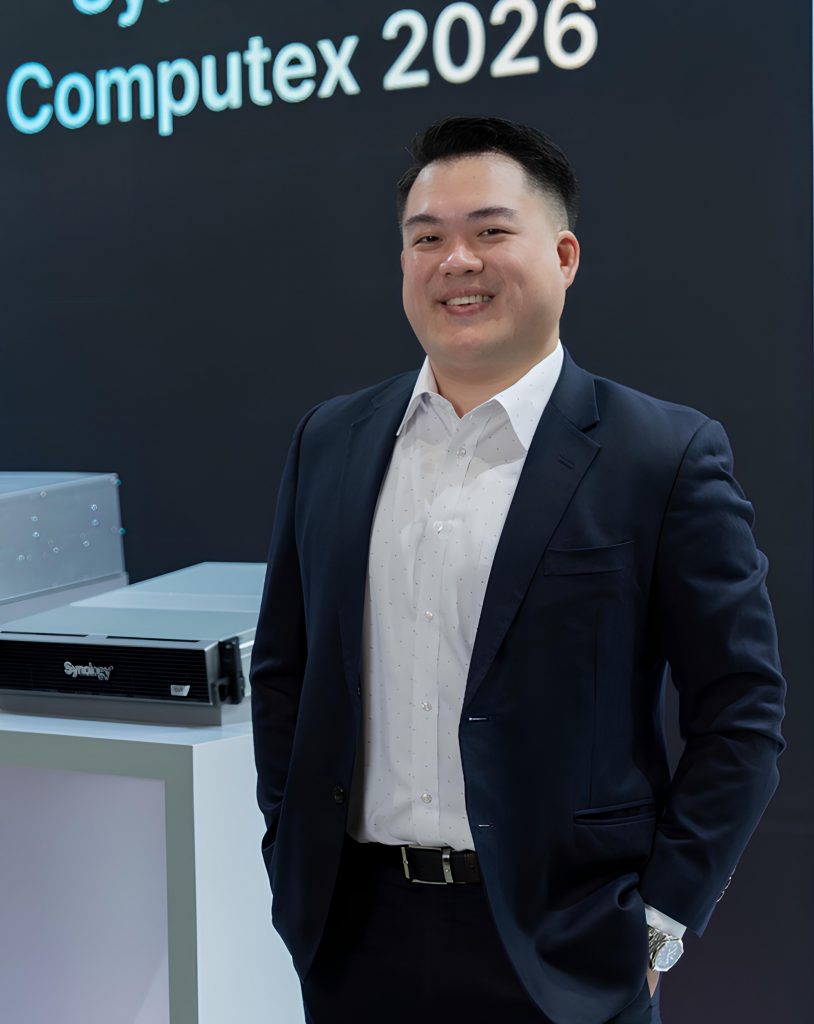
— Andrew Huang, Regional Sales Manager, Synology
For Synology, a company long associated with network-attached storage (NAS), this shift presents an opportunity to evolve beyond its traditional identity.
“Synology began as an SMB-focused storage provider, and over the years we have built a strong presence in that segment, including in India,” says Andrew Huang, Regional Sales Manager at Synology, speaking on the sidelines of COMPUTEX 2026 in Taipei. “However, our focus today extends well beyond storage. Over the past three years, we have been making a major push into the enterprise market,” he adds..
That shift reflects Synology’s broader ambition to evolve from a NAS vendor into an enterprise data management and infrastructure provider. The Taiwanese company, known for its network-attached storage (NAS) systems and on-premises data management solutions, is targeting aggressive growth in India and expects to double its business in the country over the next three years, driven largely by rising demand for enterprise-grade storage, data protection, and AI-ready infrastructure.
Synology’s NAS boxes allow enterprises, small businesses and individual consumers to store data locally offering an alternative to cloud-based storage services.
Today, Synology’s ambitions span data protection, surveillance, productivity, and AI-enabled infrastructure. Storage remains the foundation, but the company increasingly positions itself as a provider of trusted data infrastructure for the AI era.
From storage to AI infrastructure
The rapid adoption of AI is driving unprecedented demand for storage performance, scalability, and resilience. Every AI initiative depends on large volumes of data that must be collected, managed, protected, and accessed efficiently.
“Every AI initiative ultimately depends on a robust infrastructure layer, and storage sits at the center of that foundation,” Huang explains.
To address these requirements, Synology recently introduced the PAS7700, its flagship dual-controller NVMe storage platform designed for AI workloads, analytics applications, and other data-intensive enterprise environments where performance and availability are critical.
But hardware is only part of the company’s strategy.
Synology is increasingly investing in private AI environments that allow organizations to deploy AI capabilities within their own infrastructure rather than relying entirely on public cloud platforms.
“Unlike public AI services, which rely on cloud-hosted models and external data processing, our focus is on helping organizations build AI environments within their own infrastructure,” Huang says. “This enables enterprises to retain full control over their data while leveraging AI technologies securely and efficiently.”
The company is also developing GPU-enabled capabilities that will allow enterprises to run AI models and training workloads on-premises using their own data assets.
The rise of AI sovereignty
As organizations experiment with generative AI, concerns around privacy, governance, compliance, and data ownership are becoming increasingly prominent.
Many enterprises remain cautious about sending sensitive corporate information to external AI platforms, particularly in highly regulated sectors such as banking, financial services, healthcare, government, and education.
For Synology, this challenge has evolved into a core strategic focus.
“Our approach revolves around what we call true AI sovereignty,” says Huang. “Organizations should be able to centralize their digital assets in a secure environment and use AI capabilities without having to move their data outside their own infrastructure.”
The concept aligns with a broader global trend. Governments and regulators are introducing stricter requirements around data residency and privacy, while enterprises are demanding greater visibility into how AI systems access and process information.
For organizations operating under strict governance requirements, maintaining ownership and control of data is becoming non-negotiable.
“We believe the future of enterprise AI will be built around trust, ownership, and control,” Huang says.
The AI-driven storage explosion
While public discussions around AI often focus on chatbots and productivity tools, Huang believes the larger impact will be felt at the infrastructure layer.
According to him, AI fundamentally changes enterprise data economics. Every AI workflow generates additional datasets, outputs, models, derived assets, and archived records, creating exponential growth in storage requirements.
“Every AI workflow involves collecting, processing, analyzing, and often creating additional data,” he says. “In many cases, AI multiplies the volume of information organizations need to manage.”
The next wave of AI adoption is also expected to move beyond text.
“Today, much of the conversation revolves around text-based AI, but the future will increasingly involve video, images, sensor data, and other unstructured content. These workloads require significantly larger storage capacities and much faster performance.”
As a result, demand for high-performance storage infrastructure is expected to grow significantly. However, simply adding capacity will not solve the problem.
Organizations must also address increasingly complex questions around data governance, security, backup, recovery, and lifecycle management.
“As data volumes continue to grow, enterprises will need better ways to centralize, govern, and protect their information assets,” Huang says.
Growing focus on data protection
In India, Huang believes awareness around data protection remains uneven.
While large enterprises have made significant investments in cybersecurity, backup, disaster recovery, and compliance, many smaller organizations are still developing mature data protection strategies.
“One of the most significant challenges is awareness around data protection,” he says.
The challenge is becoming more important as India’s digital economy continues to expand and organizations face increasing scrutiny around data privacy and governance. The Digital Personal Data Protection (DPDP) framework is expected to further strengthen conversations around data management, security, and accountability.
As AI adoption accelerates, organizations of all sizes will need to view data protection as a business priority rather than simply an IT requirement.
“We work to help organizations understand that data is one of their most valuable business assets,” Huang says. “Protecting it should be a strategic priority, not just an IT function.”
Building through partnerships
A key pillar of Synology’s growth strategy in India is its partner ecosystem.
“System integrators are a critical part of our growth strategy,” Huang says.
As enterprises navigate increasingly complex infrastructure environments, local partners often serve as trusted advisors, helping organizations design and implement modern storage, protection, and governance frameworks.
Synology is actively expanding its network of system integrators and channel partners across the country to strengthen its reach and support enterprise customers more effectively.
The company is placing particular emphasis on sectors such as manufacturing, government, BFSI, and education, where digital transformation initiatives are creating growing demand for secure and resilient data infrastructure.
The defining question for enterprise AI
Looking ahead, Huang believes the industry will increasingly be shaped by one simple question: How much do organizations trust their own data?
As enterprises move from AI experimentation to large-scale deployment, issues such as data quality, ownership, governance, and accountability will become as important as model performance.
“Organizations are realizing that AI is only as effective as the data behind it,” he says.
For Synology, that realization underpins its long-term investment strategy.
“Our biggest priority is AI sovereignty,” Huang says. “The goal is to help enterprises build AI capabilities without compromising control over their digital assets.”
If Huang’s thesis proves correct, the next competitive advantage in enterprise AI will not come solely from access to better models. It will come from an organization’s ability to build trusted, governed, and sovereign data environments that allow those models to operate securely and effectively.
In that future, infrastructure may become as important as intelligence itself.